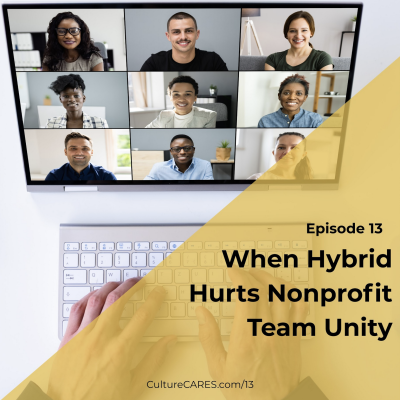
One of the toughest calls for nonprofit leaders right now is which staff members get remote flexibility and which don’t.
You’re juggling programs, fundraising, and team connection…all while trying to create policies that balance fairness, equity, and mission delivery.
But when different departments play by different rules, silos can deepen.
Here’s a common example:
💼 The Development team’s working hybrid.
👥 The Program team’s in the field.
💬 And soon, staff are whispering about fairness instead of collaborating on impact.
In today’s episode, we’re unpacking real, actionable strategies to turn hybrid work from a source of tension into a tool for trust and connection.
Let’s make your hybrid culture one where everyone feels seen, supported, and set up to thrive.
Picture a nonprofit called “Bright Futures.” Their Development team negotiated hybrid schedules: two office days, three remote. Reports and grant writing can be done from home office.
Meanwhile, the Program team — the ones running after-school programs — are expected to be on-site five days a week. Their roles really do demand presence.
On paper, it makes sense.
But In reality, it sparks division:
– Program staff ask, “Why are we stuck here while Development gets flexibility?”
– Development staff quietly wonder, “Do people think we’re not pulling our weight?”
Team cohesion suffers. Emails go unanswered, deadlines slip, and the CEO feels like they’re putting out culture fires instead of leading the mission.
This is where nonprofit leaders must recognize: the issue isn’t just policy.
The real challenge is designing a culture that communicates fairness, explains the why, and creates connection across departments.
Why Hybrid Matters to Creating Team Unity
Hybrid isn’t about sweatpants versus pants. It’s about culture design.
Your job as CEO isn’t just setting schedules, it’s creating an inclusive environment where policies inspire trust, connection, and fairness.
When hybrid design is unclear, resentment grows.
When it’s intentional and equitable, staff see leadership as credible, compassionate, and competent.
Let me share some of the hybrid research:
National Council of Nonprofits: 43% of nonprofit jobs are fully on-site, 38% hybrid, 19% remote. Direct-service roles lean on-site, while fundraising and communications lean hybrid.
Retention: Stanford research shows hybrid boosts retention by 33% and improves job satisfaction, with no measurable loss in promotion or performance IF fairness and clarity exist.
Collaboration: A study from Microsoft found fully remote teams became 25% more siloed, with fewer cross-team ties. Leaders must engineer collaboration when hybrid differs.
The lesson? Hybrid is not the villain… Unequal or unexplained hybrid policies are.
Ask yourself from 5 different lenses or perspectives:
1. Culture lens: How does our hybrid policy reinforce mutual trust & respect across teams?
2. Equity lens: Do both program and development staff experience some form of flexibility, even if it looks different?
3. Transparency lens: Have I clearly explained why policies differ by role?
4. Fairness lens: If one group carries more in-person weight, what compensations balance that out?
5. Leadership lens: Am I measuring impact and collaboration, not just presence?
5 Ideas to Spark Equity and Trust When Designing Hybrid Policies
- Create a Role Flex Matrix: Spell out what tasks require presence and what can be remote. Transparency creates trust.
- Engineer Shared Overlap: Protect 1–2 days or blocks of hours each week where all teams sync live.
- Run Opportunity Audits Monthly: Check who’s presenting to the board, who’s getting stretch assignments. Rotate intentionally.
- Offer Compensating Flex: If program staff can’t do hybrid, give them something else: shift flexibility, PTO, or meeting-free zones.
- Build Rituals of Connection: All-hands, cross-team celebrations, and quarterly retrospective/strategy meetings remind everyone they’re on the same mission.
Spark Plug Shift
This week’s Spark Plug Shift: Don’t just write down the logistics of your hybrid policy. Write down its cultural purpose.
For each role, name the reason for its in-person or hybrid requirements AND the equity step you’ll take to balance it.
Here’s an example. You could say: “Program managers are onsite because they lead community events and meet with our clients in person. To balance that, we protect their Fridays from meetings.”
Another example? “Development is hybrid because donor and grant work is digital. To balance that, they attend two culture-building days each month.”
When staff hear the why and see fairness built in, connection will strengthen.
Remember, your job as CEO or Executive Director isn’t to keep everyone happy all the time. It’s to foster an inclusive culture that inspires trust, respect, and collaboration.
Hybrid policies are one of your most visible levers to drive team unity and connection. Use them intentionally.
Until next time, lead with culture and watch your impact grow.