
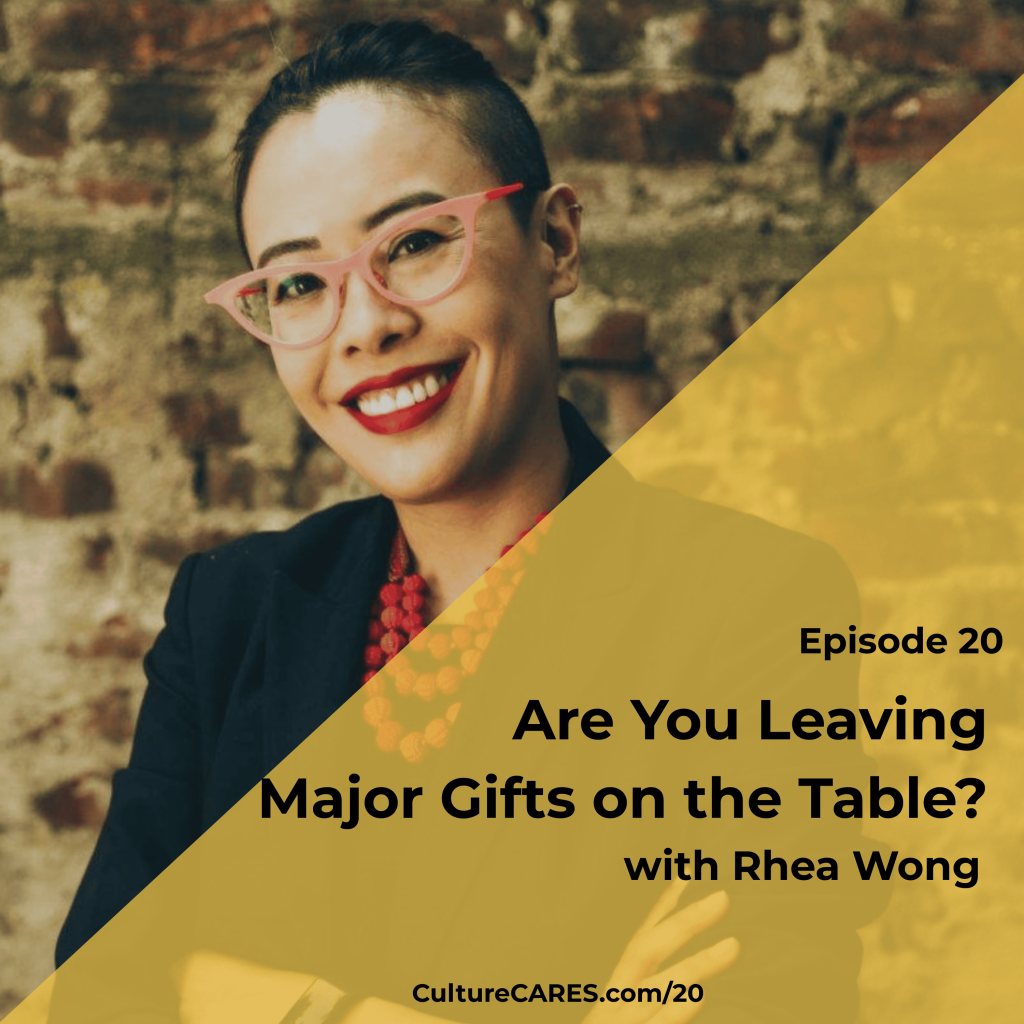
Meet Rhea Wong: From Executive Director to Major Gifts Systems Expert
Marcia Beckner
Today’s special guest has a gift for making fundraising feel less intimidating and far more empowering.
Rhea Wong is a former executive director, who has raised millions in major gifts and knows exactly how it feels to sit on your side of the fundraising table.
She brings more than 20 years of experience as a multi million dollar fundraiser, and she understands the real pressure nonprofit leaders carry when revenue goals feel both urgent and personal.
Rhea has been the one writing grant reports at 2am, pitching donors with shaky hands, and trying to balance board expectations with a team that already feels stretched.
And out of that lived experience, Rhea built the exact major gift system she wished she had as a nonprofit leader and Executive Director.
It’s a system that replaces guest work with structure and replaces anxiety with clarity, which is what I know we’re always looking for.
Today she mentors nonprofit executives across the country who are ready to build sustainable, major gift strategies that actually work without the pressure, burnout, or the “bro” sales energy that never fit in the first place.
She’s also the host of the Nonprofit Lowdown podcast and the author of Get That Money, Honey, I love the title of that book so much.
She is passionate about helping CEOs and executive directors and development teams raise more money by building fundraising systems at work. I am so excited for this conversation.
Rhea, welcome to the show.
Rhea Wong
Marcia, thank you so much for having me. It’s such a delight. I think you and I have been emailing a little bit. And so when I heard that you were starting your own podcast and you gave me an invitation.
It is just such an honor to be on with you.
Marcia Beckner
Thanks, yes, you were top of my list to connect with because I know you well.
The reason is, you’ve been an executive director before. So you’re not coming at the fundraising, major gifts, strategic work from a place of reading about it in books or just learning about it from other experts.
It really is important that when you’re working with a coach and a mentor to improve systems, that you’re working with someone who has been in their shoes.Which I know you have so beyond the short bio that I read about you.
Can you please share a little bit more context about your background and as an executive director?
Did you have an epiphany where you’re like, I want to take this work and help hundreds, if not thousands, of organizations succeed in the fundraising realm?
Rhea Wong
Oh, Marcia, if only it were that linear, that. Sounds like such a neat, “I had this epiphany moment.”
So what happened was that I was what I call an accidental fundraiser. Which I think a lot of us are out here.
I was a 26 year old executive director, and my first day on the job, I did two Google searches.
The first Google search was, what does an executive director do?
And the second was, how do you fundraise?
So this was a very small organization, and you know, over time, I did all the things. I watched the YouTube videos, I Googled, I asked to have meetings with anybody who would meet with me.
And over time, I started to develop a system and strategy for fundraising. And so over the 12 and a half years I was running my organization, we went from, I think when I started, was like 250 K a year to $3 million a year in private revenue.
So we never took public money. And of that private revenue, the vast majority of it came from individuals.
Now of course, this was New York City, so that is a very specific case.
But when you look at the numbers overall, I always like the Giving USA numbers, we see that the vast majority of giving, about 73% or 74% at last count, come from individuals.
Either individual giving or bequest, which is essentially a fancy way of saying someone dies and leaves you money in their will.
And so when I left being an ED, and frankly, it was just because after 12 and a half years, I just felt like I’d given everything I could give. Any of my EDs out here know that 12 and a half years is like dog years.
Truly, I actually joined a tech firm for about two and a half months, thinking that, like, you know, this could be the next stage of my career.
I quickly found out Tech was not for me. I lasted all of two and a half months. And I truly did not intend on being an entrepreneur. I thought I would find another job.
It just turned out that some of my friends had projects that they wanted me to work on in the interim. Sort of one project led to the next and to the next.
And then it got to a point where I was like, you know, none of these job descriptions actually are very appealing to me. And I’m really enjoying the work that I’m doing with my friends and their projects.
And when I really pivoted to major gifts, interestingly, it was during the pandemic, because that was a moment where everyone was kind of freaking out.
They had people actually coming to them, asking them to fund them, and a lot of them didn’t have strategy. And so the reason why I decided to focus on major gifts was that everything else seemed to be pretty clear.
Like, if you’re a grant writer, you understand the cadence: you get the RFP, you write up the grant, you have the site visit, you know there’s a clear kind of step by step process.
Event fundraising was the same, but nobody really had a strategy for major gifts, other than, “Oh, just meet rich people and ask them for money.”
And I was like, that’s not really a strategy. That’s just, that’s hope, right?
And for a lot of people, I just saw that the major gifts that they were getting seemed to be very random. It was like, well, it may come, it may not come.
I don’t really know. I know that, like, my board member plays golf with this person, and so, like, we asked her to ask him every you know, whatever, it just seemed very unpredictable.
And so this next phase of my career, I’ve really become a student of major gifts, and I’ve really thought about the systems, the strategy, the psychology behind it.
And one of the things that I came to realize quickly is that a lot of the ways that we teach fundraisers is couched in an old mentality, right?
Maybe this is really a strategy that was developed before we had email and digital communication and all of these messages coming at us.
And simply does not work for life in 2026 and so I’m on a single woman mission to spread the word about a new style of modern fundraising for the modern fundraiser.
The Power of Consent-Based Major Gift Systems
Marcia Beckner
I love that, Rhea, and I think you had me at the predictability comment.
My ED hat is on having been an ED myself for nearly 10 years. And the lack of predictability of in your revenue for the next year is so scary.
I had another like CEO ED friend a few years back who said, “January 1, the clock starts over. You basically have zero in your account.”
I mean, you have money in your account from the prior year, but you have to start all over.
And it’s just such it’s so intimidating, right? I never had a system. I had a list of people. Is that what you call a system? A list of…
Rhea Wong
Absolutely not, no. That is, that is the start. No.
So this is what I see often, is that people are given a list and no one really knows where this list came from, right?
And then maybe we do some qualifying, like, oh well, we did a well sprint, so we know that they have money. Or we did a Google search, and we know that they like our kind of organization.
Okay, so that’s the first step. Where I think my strategy really differentiates- and here I’m going to call out my friend Greg Warner, who was the architect of his so I don’t mind saying it’s brilliant, because it’s not my baby, it’s his baby, and I’ve really he’s allowed me to use it.
It’s this concept of a consent based approach. What do I mean by that?
When you have a list of people, you’re basically, kind of hoping that at some point you’re going to call them, you’re going to ask them for coffee.
At some point someone’s going to say yes to that. And then when they stick their head up to say “yes,” then you’re going to, quote, unquote, develop a relationship.
And at some unknown point of time, you’re going to ask them for money. And it may, or may not, be the right ask.
It may, or may not, be the right amount. It may, or may not, be the right timing. It may, or may not, be the right project, but damn it, I’m gonna ask so that’s the old way.
The new way that I really teach is, let’s take that list that you have and just consider this as our initial prospect list.
Then we look at other things. We look at, okay, so sure, do they have capacity is certainly important, because if you have no money to give, you’re obviously not going to be a donor.
But I’m also looking at other things. I’m looking at, are they on our email list? Do they open our emails? Do they come to our events? Do they take our phone calls? Do they click on our website?
These are engagement rhetorics, and then here’s where it really shines. And I don’t want to get too into the weeds here, but there’s a two step qualification process.
Because I think most nonprofits skip over qualification. And in qualification, I’m literally having a conversation with you to say:
“Hey, Marcia, based on what I hear about your interests and what you want to achieve. Philanthropically, would you allow me to present a plan for us to get to know each other? And by the way, you’re in control. You have you say when you decide if you want to opt in or opt out, and if and when it feels right, we’ll co create a proposal for funding. How does that sound?”
And the fact that you offer people the opportunity to consent into a process means that we all know what we’re doing here, right?
And so I think fundamentally, the reason why a lot of people mistrust fundraisers is there’s no consent.
There’s always the distrust like: Well, what do you want and what are you asking for? Are you going to ask me for money at a point when I’m not ready?
Nobody likes surprises. And so I think if we lead as fundraisers with the idea of, we want to be transparent. We want to be in service to our donors’ needs and desires. And we want to operate within our integrity.
It just changes the game for everybody.
Marcia Beckner
Oh my gosh, that is huge!
I’m kind of thinking that’s like a bridge conversation before you ask for money, and how critical that bridge is. Versus jumping from cliff to cliff with the ravine in the middle, and both of you don’t feel safe.
So yeah, as you were talking, I was just thinking about the CARES framework that I teach to help executive directors and CEOs build healthy, inclusive cultures where all people can thrive.
And the base of CARES is safety, psychological safety. And until you have that, people won’t be vulnerable and open up.
So having that safety conversation that you just talked about is, I feel like that’s the missing ingredient. And you just gave us what we need to succeed.
Rhea Wong
Yeah, I’m glad that you said that, because it is about psychological safety and it is about, I like the analogy of the ravine, which is like, let’s not jump randomly. Let’s have the bridge conversation.
And in fact, the other thing that I teach is that let’s have an actual process.
So it’s not I’m going to ask you if you want to be in the caseload, and then I jump to an ask.
There’s a whole piece before that, which is like, let’s co create a journey together.
“What do you want to see Marcia? Do you really like site visits? Do you really want to have coffee with whomever? Do you want to meet recipients of our program? Okay, let’s design that together so that we all know what we’re doing. We’re all on the same page, and we all know that if and when the timing is right, we are going to be co creating a proposal for funding.”
So it’s not just we’re hanging out for vibes. Like, how many times have I quote, unquote, created relationships with people?
And then it got to a point where it was like, Oh, now they think we’re friends. And now it’s awkward, because I wasn’t clear at the beginning that actually my intention was to see about a philanthropic gift, right?
So to me, it’s about, I love that psychological safety. I love that it’s about transparency. I love that it is about a process, so it’s not personal and it’s clear.
It’s like, look, we’re gonna literally lay this journey out on a piece of paper, so that you and I both know what’s coming and why.
Prioritizing the “Diamond and Gold” Levels of Leadership
Marcia Beckner
Yeah, well, now I can see why you’re a multi million dollar fundraiser.
You’re really thoughtful about your approach. And can you kind of tell us a little bit about your system?
Because if I’m an executive director right now, I’m thinking, oh my gosh, this sounds great. I love it, but I feel overwhelmed to add in.
I feel overwhelmed even though I know initially, if I put a system and a process in place, it will create so much clarity and time on the other side that I’m not spinning my wheels.
But how do you get people over that initial hump of, “Oh no, it’s something new; I don’t know it yet”
So they just kind of put it off, or don’t do it, even though it’s so important.
Rhea Wong
Yeah, I mean, Marcia, as you know, with human nature, you can’t make anyone do anything that they don’t want to do.
And I think for a lot of the people that I work with, it’s simply showing them what is not working.
Because I think, look, I’ve been in the trenches. You’ve been in the trenches like being an ED is it’s so overwhelming, you’re just fighting to keep your head above water.
And then when you talk to someone like me, and you’re like, system that seems hard, that seems like a lot.
I’m not gonna lie to you. Yes, it does take work. And my point of view on it is, if you’re really trying to build a major gift system for today and tomorrow. Hard things take effort.
It’s like, I can’t expect to be fit and in shape if I never go to the gym and I don’t give up eating pizza, right?
So the question I always have is, like, how badly do you want it?
Like, are you willing to carve out two hours a week to get this done so that you can have predictable revenue. So that you can feel confident. So that you can have a clear strategy that not just you but others on your team can follow.
If that is important to you, then we can do something. But if it’s not that important to you, or if you’d rather, I don’t know, like, focus on trying to get MacKenzie Scott to drop money on you.Then, like, we’re probably not the right fit.
So, I’m very transparent with people about, look, it does, it is going to take time. I mean, we know that on average, a major gift takes about 18 months to close, right? So major gifts are already a long game.
You can either do the long game with the strategy. Or you can do the long game and throw spaghetti at the wall, like, which, which do you prefer? I know what I prefer, but.
Marcia Beckner
Yeah, and I wish that I knew about, I mean, this program didn’t quite exist yet while I was an executive director.
But I was, you know, on the MacKenzie Scott, you know, writing her letters, and you know that too, and I didn’t know that there was a better way.
So that’s why I think this conversation is so important, so that people know if a systematic approach to generating revenue for your mission is a priority. That you’ve got to look at Rhea Wong’s information, her book: Get That Money, Honey.
Most importantly, your program where two hours a week – when you said that, I was like, “Oh, that doesn’t sound too overwhelming.”
I think that most are already spinning their wheels that two hours a week rather than building something long term.
Rhea Wong
Yeah, and I will say Marcia. So there is a system, there is a better way.
And I will say small, consistent efforts, compound. So the kinds of results that I’ve been seeing in my program, and, you know, and I don’t take credit for it. I mean, I’m impressed. I’m like, what is that?
Like I had someone close a 75k gift in a couple of weeks, just based on a couple of conversations that we could do.
I had another client of mine finally get a million dollar bequest, it had been like hanging out in la la land forever.
I had someone else close, $140,000 gift with one phone call, right?
So these things are possible. They just take a concerted effort and strategy and discipline, honestly.
Because the thing that I see a lot Marcia, and I’m sure you see it all the time, is that executive directors are just running around with their hair on fire. Doing all the things, but not being very strategic about what am I doing with my time such that it is the highest ROI leverage.
And so the way I talk about it is, if I think about the time of an ED. I think about it as a pyramid.
So at the top of the pyramid is strategy and leadership, and that’s what I’ll call the diamond level.
Below that is fundraising and marketing. That’s the gold level.
Below that is program that’s silver.
And below that is admin and operations, that’s bronze.
Where I see a lot of EDs spending a lot of time are the silver and bronze levels because they don’t know what to do at the gold and diamond levels.
Or they know that it’s important, but it’s rarely on fire.
And so very simply, the more time that you spend in diamond and gold levels, the more money you’re going to be like. That’s it. That’s the math.
Marcia Beckner
Wow! I love that way to think of it.
I haven’t thought of it that way before, and like the organizations I work with, many are struggling with like staff conflict and unresolved tension, and possibly HR investigations.
So until they can kind of clean up these dumpster fire type situations on the team, which is what my work helps them do.
I had a client last year where that’s all he was doing, and then we created, we systematized how to build culture, and got the right people in the right seats, and aligned the whole team with the right values and culture held them accountable.
Because everybody co created this culture system. And they were so excited about it that at the beginning of this year, he told me,
“I don’t know what to do with my time. Everyone’s getting along so well. I’ve never seen anything like it, and I’m not doing the work I was doing last year. It isn’t there for me? Which was, yeah, all the admin putting out fires”
And well, now we’re going to work on board, engagement, strategic fundraising, and so I’m going to share your program with him, for sure. Yeah, and he’s like, “I’m just kind of sitting around”
I thought, that is the best problem to have, because now you can be diamond gold level, working with your board, working on strategic fundraising systems and really building your vision.
And so that is just, that’s just so exciting. I love it.
Rhea Wong
Yeah. Well, the other thing too is, I’ll say, Marcia. Your work is so important, and the work that you do, to be honest, is made easier when you have money.
Because I where I see a lot of the breakdown happening in terms of culture is a lot of time when there isn’t the support or the resources available: to hire the right person or hire the right consultant or get the right training. Or you spend money on the retreat that would actually help culture.
And so, I mean, I’m not gonna say money solves all the problems, but I think money makes it much easier to solve the problems, which is why fundraising.
Marcia Beckner
And we can have a debate about that, for sure. Because my perspective is that unless the culture is churning and everyone’s rowing in the same direction, then the money will come.
And I’ve seen, you know, results like that, but they are really two sides of the same coin, because obviously, there’s no money, there’s so much stress, exactly.
Rhea Wong
I mean, I don’t disagree with you. I think the work that you do gets everyone aligned, which then drives more money coming in.
But at the core of it, it’s hard to get everyone aligned if there’s no money to pay for people’s salary or, like, when you’re in that scarcity of survival mindset.
So I don’t think we disagree. I think, yeah, I’m I’m just of the perspective that, like, “No money, no honey.”
2026 Trends: Small is the New Big
Marcia Beckner
That’s true. No money, no mission, and no people to help you fulfill that.
Are there any 2026 trends? I know there’s quite a few of them.
But can you pick out the one, number one, most important one, you think that executive director could use that you are aware of?
Rhea Wong
Yes, yes, yes. I’m so glad you asked this question. I am going to die on this hill.
Small is the new big.
What do I mean by that?
When we look at philanthropic gifts across the board, we know that a small majority of people are responsible for the bigger gifts overall.
So it looks like 10% of the people are responsible for 90% of the giving.
And what is happening, especially in this age of AI and you know, mass emails and social media, etc, is that everyone is yelling at everybody all of the time, and there’s a lot of noise out there, right?
Like, I can’t, like, I open my email, I get like, 100 emails from all these people trying to sell me things.
I open my LinkedIn, I got a bajillion people like, trying to pitch me on something.
My phone, you know, has all these voicemails like, it just is totally overwhelming.
And so what I think we need to do as fundraisers is zig while everybody is zagging.
What that means is doubling down on the small, the intimate, the authentic, the genuine, the real conversations with your donors, not the mass email, right?
And so sometimes to scale, you must do things that don’t scale.
And so when I work with my executive directors, for example, or my development directors, they’ll say things like, “Well, I’m just so busy I don’t have time to pick up the phone.”
Is it that you don’t have time, or is it that you are uncomfortable doing it, and therefore make work to do in order to just tell yourself that you don’t have the time to do it.
I get it. It’s uncomfortable to be vulnerable. It’s uncomfortable to pick up the phone. It’s uncomfortable to have a conversation.
And if you’re telling me that you’re spending 30 minutes designing an email, I would make an argument that that’s a better 30 minutes spent actually picking up the phone to talk to your donors.
Marcia Beckner
Yeah, I see that.
Kind of what I’ve been learning recently is that we’re in a new economy called the engagement economy, which is two way conversation, not just one too many on social media and email.
And those definitely have their place for nurturing, but to really engage and get a donation, I don’t think I’ve ever gotten a donation from an email or a social media post or a Facebook post or, you know.
Rhea Wong
Well, email I would say, statistically, email is actually pretty decent at ROI.
But social media generally tends not to be. I mean, social has its place. I think social is really good for brand awareness.
I think most nonprofits aren’t using social strategically as a way to build their email list, and therefore to nurture and therefore to build relationships such that you can build your way into a solicitation.
Or the way I like to think of it is, have earned the right to ask.
Because I think so many of us have been raised in this transactional mindset that is like, okay, I’ll just send a bunch of emails, and then at the end of the year, I’ll do a campaign, and then I’ll ask people for money without ever asking myself:
What value have I created for my donors along the way?
What kind of relationship have I actually designed such that it is, to your point, an engagement, a two way street? (As opposed to a transactional like, okay, now, give me, give me, give me, right?)
Nobody likes to feel like an ATM and unfortunately, you know, and no fault of their own. I think a lot of people have not been trained differently.
And I think because of the constant weight of the need to fundraise it, it just is easier to be in transactional mode than it is in relational mode.
Marcia Beckner
Yeah, yeah. It’s just, it’s hard. It’s sales.
I did work in the tech industry for seven years, and I sold massive, million dollar computer systems.
And then I went and I started my nonprofit, and I was an executive director, building something from scratch. And the hardest sales I ever did was asking for donations and event sponsorships and grants.
And it is sales and you’re selling that kind of invisible-like mission, and invisible to the donor, usually.
Rhea Wong
Marcia, can I? Can I interject? I think there are some similarities to sale, but it is fundamentally a different thing. And the reason why is couched in brain science.
So, Dr. Russell James out in Texas, put people in MRI machines.
And he scanned their brain while they were talking about business, and one part of the brain lit up.
And then he scanned a different part of the brain when he was talking about philanthropy, and it’s the same part of the brain that lights up when we talk about emotion, when we talk about family.
So fundamentally, these are different parts of the brain. And I think when we lead with data as an example, that’s very logically centered for that part of the brain, but that is not the same part of the brain that’s engaged in philanthropy.
And so there are some similarities to sales, but the drivers are different.
Marcia Beckner
So family and emotions, and when it impacts either of those, then…
Rhea Wong
That’s where generosity lies in the brain. And it’s very story oriented.
That’s why we talk about using story a lot, because we’re trying to stimulate the emotional center of the brain, not the logical center.
And so I imagine, when you were doing sales, you led with a lot of benefits, right? Like, oh, it will save you time, it will save you…
That’s a very logical case that you’re making, and it’s not wrong, but philanthropy is inherently emotional.
Marcia Beckner
I see, okay. I thank you. I love learning about neuroscience and how the brain works, so I appreciate that.
As we’re wrapping up, are there any real practical, tactical takeaways that someone can do tomorrow to get started on this journey into building a major gift system that you recommend?
Rhea Wong
Well, I would say, visit my website. I have free webinars every month where I talk about the system. I talk about this, the strategy: RheaWong.com.
But if I were to say first thing first, I mean, I would look at that list. Because everyone has that list, and, like, lord knows where that list came from, and I would triage it.
So based on what you know about these people, who is actually… Who has capacity? Who is actually engaged? Who actually has any kind of relationship with us?
And then rank your list between A, B and C, and spend your time on qualifying the A’s. And once you’re done with that, then you qualify the B’s, then you qualify the C’s.
So you’re systematically working through your list, and you’re not relying on hope as a strategy, right?
There’s always like, oh, there’s like, this big, fancy billionaire on my list, like, maybe one day with the right email, this person is going to give us money.
I’m like, You know what? I’m not a vibes kind of a person. I am a data kind of a person. So if you want to base your entire strategy on vibes and like, that’s absolutely fine. You can do that.
However, if you’re looking for a bit more strategy, that’s one quick thing you can do.
Marcia Beckner
I love that. Thank you and I just want to spell your name for your website. It’s Rhea Wong, R, H, E, A, W, O, N, G dot com, and you can find all the resources that Rhea offers there.
And also, do you have something else to offer today?
Rhea Wong
I do. I do. So, okay, so your audience. I’m going to give the major donor cheat sheet.
So I’ll share the link with you. You can share it with your audience afterwards.
And it is a quick cheat sheet with scripts of how you can move a major donor conversation forward.
Marcia Beckner
Major donor cheat sheet. It’s called the major donor cheat sheet.
Okay, all right. Well, thank you for creating that for our audience. We really appreciate your time. Rhea, is there anything else you want to share before we wrap up?
Rhea Wong
Yeah, I know I feel like I’ve been beating up on people a lot, and I know this is a really hard job.
And I just want to say I’ve been in the trenches. You’ve been in the trenches as well. And anything I can do to make this very, very hard job a little bit easier, even if it’s providing tools and templates or strategy.
The job is hard enough; we’re literally trying to change the world. Let’s just make it easy, or as easy as it possibly can be.
Marcia Beckner
Yeah. I mean, we’re doing no one any good if we’re all burning out, stressed, overwhelmed and not able to stay in the sector that we care so much about.
So Rhea, thank you so much for being an expert in the field and raising the flag for systematizing such an important fundraising program that can really help missions go farther.
I really appreciate this conversation, and we will be in touch again soon.
Rhea Wong
Okay, well, Marcia, we’re going to have you on my podcast, so this is going to be great.But thanks for the invitation.
Thanks for all you do. It’s very, very important work to heal the culture. As being in the sector, I know more than enough about how things can go awry from a culture perspective.
So yeah, so we’ll be talking about that soon, but thank you so much for the invitation.
Marcia Beckner
Thank you.
Thanks for listening to today’s episode of Nonprofit CEO SPARK.
If you’re ready to turn burnout into boundaries and build a healthy, happy culture where everyone, including you, can thrive, visit culturecares.com to learn how I support nonprofit organizations like yours.
If this episode brought you value, share it with a fellow leader, navigating stress and overwhelm and remember you are meant for great things, and you don’t have to burn out to prove it.
Until next time, keep leading with courage and confidence.