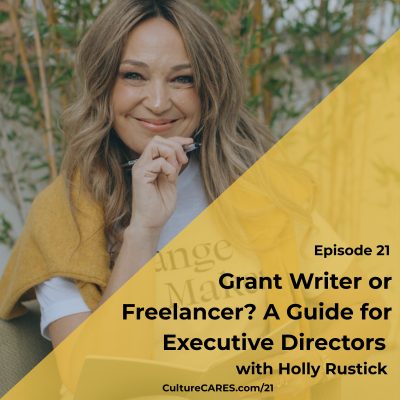
Welcome to the nonprofit CEO spark podcast. I’m your host. Marcia Beckner, today’s guest is Holly Rustick, a world-renowned grant writing expert, best-selling author, and host of the top ranked podcast called Grant Writing and Funding.
I had the honor of being a guest on her show a couple weeks ago. With more than 20 years of experience, Holly helps writers leave their nonprofit jobs behind and replace their full time income by writing grants part time from home.
Through her signature programs, the freelance grant writing Academy and grant professional mentorship, she teaches writers how to master the craft and the business side of building a sustainable, profitable freelance career.
Since 2023 her students have collectively secured more than $260 million—I’ll say that again, $260 million—in grant awards and generated over $7.6 million in revenue in their own businesses.
She’s also the founder of the ambitious $1 billion for good movement aiming to help her students win $1 billion in grants and build $30 million in grant writing business by 2030.
Holly holds a Master’s Degree in International Political Economy, is a four-time author, and has been recognized for her leadership in anti human trafficking advocacy. She lives on the island of Guam with her daughter. Welcome to the show, Holly.
Holly Rustick Thank you, Marcia. I’m so excited to be here on your podcast this time. So as you mentioned, you’ve been online, so I love it.
From Indonesia to DC
Marcia Beckner I’m excited to interview you and learn more about how you can directly impact the lives of the nonprofit CEOs and executive directors listening here today.
Can you give us a little bit more context around why you do what you do, and if you had an epiphany like this is your life’s calling?
Holly Rustick Yeah. I mean, I definitely, you know, I’ve been in this space for more than 20 years writing grants and I really always just loved it. Like many grant writers, I kind of fell into it.
There’s not really a “grant writer pathway” from high school; you just kind of fall into it. I fell into it during the Asian tsunami back in 2004 when I went to Indonesia to do community work.
I just knew people in the community who saw these big UN organizations and knew there was money available, but they didn’t know how to tap into those funds or overcome the language barrier.
I realized I could help and became the liaison between money and mission. That’s always stuck with me; that’s what a grant writer is. Then I realized, oh, that’s writing grants.
In 2006 or 2007, I worked at a virtual grant writing company outside of DC. No one had really heard of that back then, but it was a great start.
The Transition to Freelancing and Internal Nonprofit Culture
Holly Rustick
I wanted to go to Europe to do my masters and asked if I could keep working for them over there since it was a virtual business. I didn’t know that was called freelancing at the time.
I did that for quite a while, living in many other countries like the Middle East while doing freelance grant writing on the side. I moved to Guam in 2011 and started working inside a nonprofit.
I did that for several years, writing grants and eventually being the Acting Executive Director. I was basically doing the thing—working three jobs and getting paid for one.
I realized that even though the nonprofit was doing wonderful work with substance use and anti human trafficking, the internal culture was difficult.
Systemic Issues: Toxicity and the “Cause” Guilt
Holly Rustick
The culture was almost guilt-based; you were expected to work like crazy for “the cause.” If you weren’t working as hard as the executive director, the unsaid implication was that you didn’t care enough.
I saw this in other nonprofits too and realized it was the norm. My research found that nonprofits often have an inherent culture of toxicity because of how they were formed and institutionalized.
If you go back to the civil rights movement era when 501(c)(3)s became institutionalized by the IRS, it was a way for the government to control movements.
That’s why it’s hard to get grant money for preventative services or restructuring entire landscapes, but easy to get it for project-based assistance after the fact. It’s done on purpose.
Holly Rustick
There’s also a cultural history of charitable work being seen as unpaid labor for wealthy socialites. Now, it’s a career path, but the toxicity of that systemic origin remains.
There are still many gender pay gaps. As a nonprofit grows over a million dollars, the gap widens. In smaller ones, more women lead, but as the money increases, more men take charge.
I’ve worked with Amy Cross on “Gender Fair” to analyze nonprofits for gender parity and institutionalization. I want to paint the picture of the system so people don’t just point fingers at individuals.
Your board might be lovely people, but the nonprofit can still be toxic because of the culture. It’s not really their fault; it’s just where we are, and we need to change it.
Executive Director vs. CEO: A Mindset Shift
Marcia Beckner I love it. It’s a lot to process. I’d love to put the pay gap information in the show notes because I’m passionate about women and men being paid fairly.
Regarding the role of the person accountable for success, is there a different definition for a “CEO” versus an “Executive Director” specifically in our sector?
Holly Rustick That’s a good question. Some use them interchangeably, but they aren’t exactly the same. Sarah Liviary once said we should stop using “Executive Director” and start using “CEO” all the time.
A nonprofit is a business. “Executive Director” sounds like you’re just running a charity, while “CEO” sounds like business-corporate speak.
Positioning yourself as a CEO helps your mindset. It shifts you from “I’m wearing a zillion hats and working all weekend for the cause” to “I’m running a business that needs systems and delegation.”
Redefining Identity: Compassion vs. Martyrdom
Marcia Beckner That is exactly what I’m trying to do with this podcast. Truly, when I started my organization, I was a CEO responsible for profit and loss, payroll, and everything else.
However, the “Executive Director” identity often feels more humble and demure. Many people in our industry are full of heart and feel uncomfortable with the “CEO” title.
Holly Rustick You can be a CEO that is compassionate and empathetic. There is a tabooness around it because we feel we have to be the martyr.
You can be passionate and still have boundaries. If you work all weekend as a martyr, your staff will feel guilted into doing the same and become burned out and bitter.
Do you want an environment where people stay because they are loyal, or because they are guilted? Set your emails to send on Monday morning and stop trying to prove how humble you are.
Marcia Beckner I’ve worked at nonprofits where leaders text at 7:30 AM on a Saturday about non-urgent things. That normalization creates a toxic environment.
If leaders set boundaries and work-life balance, they subconsciously give permission to the rest of the team to do the same. Ultimately, everyone is more energized and productive.
Holly Rustick My friend Sean Kosofsky ran a project with a four-day work week for a national nonprofit. They saw more productivity, decreased meetings, and massive energy from the staff.
I think there is a shift happening, but it’s not big enough yet. During COVID there was chatter about it, but now many structures are shifting back to “normal.”
We are seeing a lot of nonprofit professionals quitting and going into freelancing or consulting because the structure of the office hasn’t truly changed.
The Freelance Alternative: Taking Destiny Into Your Own Hands
Marcia Beckner It takes time to change systems from the civil rights era, but it’s not where it needs to be yet. You’re an advocate for health and well-being through freelancing.
If someone can’t find balance in their job, you’re saying there’s another way. I want to hear more about that alternative.
Holly Rustick Even if you love where you are, you should open a side business. You have skills you can access to get a client on the side.
If you work in finance or as an Executive Director, you know how fragile nonprofit budgets can be. In 2025 and 2026, we saw many nonprofits streamline budgets and lay people off.
Those people had no business experience and no savings because nonprofits often have slim fringe benefits. We don’t want you to feel desperate or stressed about what to take.
Holly Rustick
You have the ability to have some savings by taking a client for even just 10 hours a month. If your workplace is healthy, you have time for that.
Nonprofits are looking for specialized skills—grant writing, fundraising events, donor development, or marketing—because they are running lean budgets.
The highest percentage of a budget is usually personnel and fringe benefits. Nonprofits can’t always afford full-time staff, so they hire people with specific skills for fewer hours.
Freelancing is often more stable than a “job.” I’ve worked with enough nonprofits to know what the budgets really look like; the reality is that no one is truly secure.
Navigating Career Changes: Conversations with Boards and ROI
Holly Rustick
Serving more people is important. In our Academy, we help you position your current job or even help you quit it by reprocessing how you track your time.
We teach you how to have a data-driven conversation with your board. You can say, “You hired me for an ROI, but I’m doing all these other things that prevent me from reaching goals.”
If you want to stay, get your job cleaned up. Many people end up turning their full-time position into their first “anchor client” through consulting.
It’s better to do the main things that get the highest ROI, like grant writing, rather than doing “all the other stuff” that leads to burnout.
Empowering Women in the Sector through Coaching
Holly Rustick
Eighty-two percent of freelance grant writers are female. Many of these women haven’t been paid what they need, or they need flexibility for childcare or caring for loved ones.
Flexibility is often even more important than the finances. Many women pull a “toxic” mindset into their own business, so we do a lot of mindset coaching.
We teach them how to price services and stop throwing discounts before people even ask for them. We are trying to completely transform the sector.
We want women to have boundary-driven conversations. Nonprofits are often impressed by these boundaries and end up carrying that healthy culture back into their own organizations.
Marcia Beckner I had a client who was an Executive Director going through distressing HR situations and investigations. She was at the end of her rope but decided to stay until things improved.
We worked together to turn the culture around so her successor would have a healthy environment. After hiring the new person, she became their freelance grant writer.
She gained the flexibility she needed for her aging parents and young children while still serving the cause she loved. It was a win-win for everyone.
I know there are many people like her out there. Your program helps them shortcut how to price services, find clients, and implement effective systems.
Hiring Strategies: Staff vs. Freelance
Marcia Beckner
If an executive director needs to hire help because their plate is too full, how do they decide between a full-time employee or a freelancer?
Holly Rustick That’s a good question. You have to look at your budget first. Don’t hire a “unicorn” person if you haven’t actually budgeted for what they are asking for.
One of the most ethical things you can do is put the salary range in the job application. It sets expectations and prevents people from feeling underpaid later on.
Also, figure out exactly what you need. Don’t hire a grant writer and then make them run fundraisers and marketing. Let them do the one thing that provides the highest ROI.
If you hire someone without skills, please pay for their training. Don’t just expect them to figure it out on their own.
Holly Rustick
Transparency is key. If you are clear from the start, people agree to the price and there is no “weirdness” later regarding qualifications versus pay.
Really understand your needs before you post. If you just need gaps filled, that is unhealthy. You want someone focused on the specific goal you hired them for.
Holly Rustick
People think a staff member will be more loyal, but I don’t think that’s true. Freelancers love their clients and work hard to keep them through annual renewals.
A staff person who is tired might be cruising other job listings during the day. I actually think consultants can be more loyal because your success is their business.
With a freelancer, you aren’t paying for fringe benefits, health care, or taxes. They embed that in their own pricing so you don’t have to manage the payroll.
You also don’t have to pay for an office, internet, or computers that crash. Overall, hiring a freelancer can significantly reduce your total costs.
Holly Rustick
A monthly retainer might seem high, but it is often less than a staff person’s total cost when you add up all the hidden benefits and overhead.
Plus, you get someone who gets to “hang out” and do exactly what they are good at. They aren’t distracted by office politics or other unrelated tasks.
Specialization and Self-Management in Freelancing
Holly Rustick
You can find someone who specializes in foundation grants, federal grants, or a specific cause area. They are often more competitive than a generalist staff writer.
The biggest bonus is that you don’t have to manage them. Consultants facilitate the meetings, bring the agenda, and manage the timeline of what is being worked on.
This clears up massive brain space for the CEO. You don’t have to manage and delegate every tiny detail because they already “got you.”
If you hire someone who uses hourly pricing or doesn’t know their pricing on a call, they might not be seasoned enough. Look for those red flags.
Holly Rustick
We have a grant writer directory at grantwritingandfunding.com where you can search by state or cause area. We vet the people on our website.
We’ve reviewed at least four of their grants or confirmed they have won at least four. They are all in our program, so we know they have the training.
Resources and Next Steps for Aspiring Writers
Marcia Beckner I want to get your details for the show notes. What is your website address, and what program do you recommend for future freelance grant writers?
Holly Rustick Go to Grantwritingandfunding.com. We also have a podcast by the same name. If you’re new, the Freelance Grant Writer Academy is perfect for you.
We provide training, unlimited grant reviews, and business acumen help. We help you with pricing, offers, and getting your first clients to replace your income within a year.
The Grant Professional Mentorship is for those who are more mature and ready to scale. We also have a YouTube channel and various freebies.
Preventing Burnout and Reclaiming Health
Marcia Beckner You also have a book called The Beginner’s Guide to Grant Writing on Amazon. You truly are the expert.
As we wrap up, is there any last piece of advice or tactical thing that an Executive Director or writer can take on quickly?
Holly Rustick If you’re burned out, we need to stop that now. There are ways to create better boundaries, but I also recommend getting a client on the side.
It’s not selfish to want retirement and financial security for your kids. It is empowering. Journal a bit to see if you are just burned out or need a total change.
Tell your nonprofit you need a week off to recalibrate. Give yourself a break and do some thinking about what is right for you.
Marcia Beckner If you’re really burnt out, go to culturecares.com and schedule a “Burnout to Boundary” session. It’s a private, 90-minute conversation.
The most important thing is that you don’t stay there. You are worth having an empowering career while taking care of your own well-being.
Holly Rustick When you are healthy, you can have so much more impact. We call our students “change makers” because they help so many more organizations once they have their health back.
Marcia Beckner Thanks, Holly. Thank you to our audience for tuning in. If you’re ready to build a healthy culture, visit culturecares.com.
If this episode brought you value, share it with a fellow leader. Remember, you are meant for great things, and you don’t have to burn out to prove it. Keep leading with courage.