
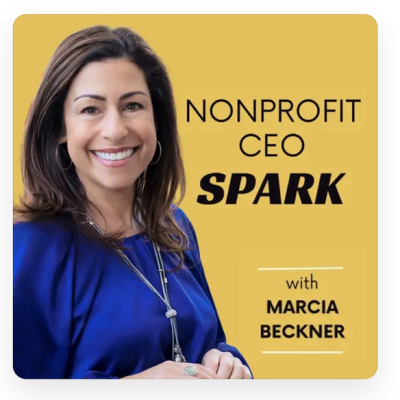
The Lever for Organizational Growth
Marcia Beckner
What if the single greatest lever for your organization’s growth isn’t your next fundraising strategy, your next hire or your next big idea?
What if it’s your board?
Because an effective, engaged board can accelerate your organization in a way that almost nothing else can and if you don’t believe me, you’ve got to listen to this conversation, because when it’s not working, it quietly holds everything back.
And here’s the uncomfortable part, it doesn’t just come down to the board alone.
It comes down to shared accountability with the CEO and Executive Director today, you’re going to hear exactly what most leaders are getting wrong and how to fix it, with guidance from someone who has helped move 10s of millions of dollars into mission driven work.
I’m talking about my guest today, Melanie Ulle.
She is a visionary founder and CEO of philanthropy expert.
She has advised donors and philanthropists on how to give more than $20 million with real intention and impact.
She’s been featured on platforms like the Today Show, The Wall Street Journal, the Associated Press and the Denver Post.
And her work has even been highlighted by get this Martha Stewart herself.
Melanie has earned her degree in international political economy from Colorado College, and her leadership has been recognized in philanthropic Leader of the Year by the Denver foundation and as one of Colorado’s 25 most powerful women by the Colorado women’s Chamber of Commerce.
She is so impressive and but what I think you’re really going to appreciate in this conversation is how practical this becomes, what actually works, what doesn’t, and what you can start doing immediately to create a board that is engaged, align and fully invested in your mission.
And at one point we bring it all the way back to something surprisingly simple, which I love, a single idea echoed in how the Dalai Lama talks about solving the world’s biggest problems, and once you hear it, you’ll start to see exactly how it applies to your board, your leadership and your organization.
So if you’ve been thinking about how to grow, how to lead with more confidence and how to finally get your board operating as a true partner.
Stay with us, and let’s dive in with Melanie Ulle.
Marcia Beckner
Welcome to nonprofit CEO Spark, the podcast for bold leaders ready to navigate growth and change with energy and confidence.
I’m Marcia Beckner, nonprofit founder, former executive director and culture strategist, with nearly 20 years in the social impact world, each week, I help nonprofit leaders stop spinning out set boundaries and design inclusive cultures where all staff can thrive if you’re ready to reignite your leadership without sacrificing your well being, hit subscribe and let’s spark your next chapter together.
Marcia Beckner
Mel, welcome to the show.
Melanie Ulle
Thanks, Marcia, I’m so happy to be here.
I feel so lucky and honored.
Marcia Beckner
Well, I am so excited that we’re going to talk about a topic that is a passion of both of ours, and that is how to help CEOs and executive directors really connect and engage and develop their board of directors.
This is a hot topic Everywhere I look, and you are an expert in this, so I’m super excited to dive in.
Melanie Ulle
Awesome me too.
I mean, this is probably my favorite topic, so thank you for giving me…
Marcia Beckner
And why is this your favorite topic?
The Power of Shared Accountability
Melanie Ulle
I think it’s my favorite topic because I’ve worked for organizations that have effective boards, like effective in fundraising, effective in mission, effective in generative discussion, in strategy.
And I’ve worked with boards that are terrible at all of those, or good at one thing and bad at everything else.
And I really believe in boards.
A lot of consultants that I am very close to have just told me, You know what we’re done.
We give up on boards.
They don’t do what they say they’re going to do. We quit. We’re we’re making everything happen at a staff level.
I don’t believe that’s I don’t believe that’s true, and I sit on a highly effective board, and I hope that I’ve been part of helping make it an effective board, and I was the head of development for an organization that had what I think is one of the most effective boards I’ve ever seen in practice.
And so I just, I know, I know what boards can do.
They have real power.
They have real, real power.
And if we set them loose, and that’s why I do.
I would challenge you to say, when you ask about what executive directors can do, I think executive directors have to let go, and then they have to allow board chairs and boards to do their thing and not not overly manage them, and also not be a crutch for them.
And I think it’s that lack of accountability.
That lack of accountability is where everything falls apart.
And so I really hope we can spend a lot of time talking about that today.
Marcia Beckner
Yeah, let’s do that, because I know a lot of executive directors out there feel that first way that you’re talking about like, I’ve tried everything I really don’t know what I’m doing.
They tell me things like, I’m afraid to admit what I don’t know, and so they’re not taking steps to further engage the board in fundraising and governance activities, because they’re not sure how, and they’re not even sure if it’s worth all the time and effort.
So what do you have to say in those situations?
Melanie Ulle
I think that everyone is misunderstanding their role, right?
Okay, the executive director reports to the board.
The executive director doesn’t have a board that reports to them.
It may feel that way 90% of the time, but that is not, in actuality, the way that governance works.
And so in optimal boards, you have a really amazing team that is working with you.
Yes, you report to them, but they are your colleagues, and you are accountable to each other.
You are equally accountable to each other.
So when a board member, when you ask a board member for something, they treat you like a peer.
They don’t treat you like you’re somebody who works for me, I can respond when I feel like it, it this, this lack of accountability toward one another is, I think, where everything falls apart, and lack of accountability for board members to each other.
And I think the best boards are highly, highly accountable, to the point where they’re not 100% accountable, they’re 150% accountable.
And if my husband heard me say that, he would roll his eyes, and he would say there’s only one, there’s only 100% there’s no such thing as 150% but actually, I learned this from a client of mine the other side Academy.
There is such a thing as 150% accountability, and I hope that we can dig into that today.
Marcia Beckner
Yeah, well, let’s dig in right now.
Like, what does that mean 150% accountability?
If there’s an executive director out there saying, oh my gosh, I can barely get them to read the board minutes and show up to a meeting.
Like, what is 100% accountability mean mutual and what does 150 mean?
Like, let’s define that.
Melanie Ulle
100% you are 100% responsible for your own actions, your own integrity, your own work.
That’s 100% I am responsible for Melanie Yuli all day, every day, right?
But I am also, when I’m in a board setting, I am 50% responsible for the actions and the integrity of everyone else in the room.
So when I see that Marcia is dragging her feet, and Marcia said she was going to contact these three potential, you know, event sponsors, and she didn’t then I am going to forego niceties and I’m going to hold Marcia accountable, because that is fiduciary responsibility.
The problem that we have developed as a culture in this nonprofit world is that we have developed this culture where we think that being nice is fiduciary responsibility.
No in fact, being transparent, being authentic, being honest and holding each other accountable is fiduciary responsibility.
And more important than all of that, holding ourselves accountable.
If every board that you worked with, Marcia, if all of your clients, boards did exactly what they said they were going to do, imagine how much money they would raise.
Imagine if they actually just did one thing, just did what they said they were going to do.
You as an executive director, not you, you are a former executive director, but as an executive director, you can only hold them so accountable, because at the end of the day, they’re your boss, right?
You report to them, and the only people who can really hold each other accountable, they really are the board members holding each other accountable you.
But this is the job of the executive director.
You have to do everything you say you’re going to do right.
You have to be 100% accountable so, and I think that it isn’t the job of the executive director to then hold the board accountable, because that’s not your job, like they’re your bosses.
That’s insane.
That’s absolutely bananas, right?
But they can hold each other accountable.
Transitioning Beyond the Founding Board
Marcia Beckner
It makes so much sense.
I mean, it all comes down to to me.
I’m thinking of recruitment and getting, not just recruitment, getting people on the board who can help grow your organization and support it through governance and fundraising, but also training the board like, this is your responsibility.
I think a lot of board members are on there because they were a volunteer for a program, and now and then the Executive Director feels like desperate that.
Somebody is leaving their board, and they need to just fill a seat, and they just tell that volunteer, please come on to our board.
You won’t have to do anything, you know.
And I get it. I’ve so..
Melanie Ulle
We all get it right. We’ve all seen it. We’ve all been there.
And at the beginning, listen.
Boards have a trajectory, and we all know that the first board you have, if you’re a founder in this is probably the case for you or your buddies, right?
It’s your friends, you like, find the people in your innermost circle, and then, as you grow as a board, then you’re going out, like an onion, layer out, and then you’re you continue going an onion, layer out, an onion layer out.
Because now it’s not your baby anymore. It’s the community’s baby.
If it’s still your baby, you have failed as a founder, right?
If, if the community doesn’t own the mission, then the mission wasn’t worth it in the first place.
I mean, I this very harsh, but it’s very true.
We have 64 nonprofit clients.
I see it every day, like there, there are organizations that that flourish because they grow, and there are organizations that aren’t going to make it because they just stay in this little insular world that is like the the sandbox of the founder, right?
And a lot of founders like that.
A lot of founders don’t actually want a generative board who’s doing generative work.
Who’s pushing the envelope creating ambitious strategy.
They just want to keep it, you know, easy, simple, controllable.
What’s the point? Man?
Just start a for profit and do that yourself then.
Because if you don’t want the community to own it, you shouldn’t have 501, c3, status in the first place.
Marcia Beckner
Yeah. And so, getting back to the board, so there’s a founder level board, right?
When you start an organization, I want to talk about how to grow it to that next onion layer, and then that next one, and how to think about it.
Do you think is it like a certain, like, revenue amount, where you’re like now that you’re at a million and you want to go to, you know, 234, $5 million organization that grows the community impact is like, when does a founding board need to move into that governance board?
And I know it’s not like a straight line, easy path. It’s kind of a spiral, right?
Melanie Ulle
I think you can feel it.
I think you probably will remember this in your own journey.
Yeah, there was this moment where you were building something together.
You were, and maybe it was your friends, but you were all building this baby together.
You were, I think, about the founding board of I was a founding board member for the girls athletic leadership schools, gals, which is still a client of our firm.
Um, I was board member.
Then they became a client. We worked with them for 14 years.
When we first started gals, that was the most exciting board experience ever.
Because we were building we had to do things.
We didn’t have a staff, we didn’t have a team.
Like, we had to, like, really find a location.
Look at a million churches, look at all these weird locations to say, Where are we going to have our first class?
Because, you know, you start with a charter school, you start with grade one, and then you add grade two, and then you add so.
So it was this, like crazy, wonderful, hard experience.
You can feel it when you start becoming a rubber Stampy board that this is the time when baby board is time.
It’s time for me to transition off.
Now, you need people with more expertise who can help it go to the next level.
I think there’s a natural like, sense that Eek, I’ve sort of exhausted my resources as a board member.
We’re going to the next level now, like, my $300 isn’t going to do it anymore, you know, right?
Marcia Beckner
I could see, like from the baby board.
I love that visual and trying to grow into a healthy adult, that there’s that teenager, I guess that was the messy middle.
Melanie Ulle
It’s an awkward teenager, it is.
And it’s the people who want to stay on because they love the baby so much, and they were part of it.
And so part of it is just like, I swear it’s just being accountable and honest all the time about what am I still offering as a board member?
What are you still offering as a board member?
You know, Marcia, you brought all of this energy and creativity at the beginning now that we’ve moved into a different era, like, do you still feel like you’re relevant?
And if you are still relevant, tell me where you’re going to play in the sandbox of this board.
Tell me what you are going to do.
I think if we’re all really looking at ourselves and looking at each other, looking at our board matrix, what do we need now we’re starting at high school, okay, what does that mean?
Okay, that might need additional governance.
It might mean recruitment. Maybe we need to do marketing.
Like, we’re going to have to scale by 400 more kids.
Like, what does this look like?
Always, constantly assessing the needs of the organization to see if we’re a match anymore.
And really being honest, I’ve had to be honest as a board member when I’ve outgrown the board where, or I guess, the board has outgrown me, like the organization has outgrown me, and I’m no longer the right fit.
I’ve had to accept that that’s hard, but.
I think if we’re always being honest with each other and always putting our best foot forward, it, you know, this is sounds so stupid, but the I think about this a lot, I may have even said this to you conversationally before I listened to a podcast, and I think it was the Dan Harris podcast, like years ago, and he had visited, or he was, he was doing an interview with the Dalai Lama.
And there were, there were these kids who had had gone to, I think, dharma Sala, to meet with the Dalai Lama and and they were bringing up all of these things with him, saying, like, but what about, you know, all these horrors in the world, like, what can you do to solve them?
And he kept saying, the solution is love.
The solution is love.
And they were like, okay, but no, like, you actually have to do something.
And he he explained, with love is like honesty.
And with love there’s no environmental degradation, sorry.
There’s no racism, there’s no sexism, there’s no war, there’s no poverty.
If you lead with love, everything works, and I think that way about like our role is board members.
If I really love this mission, I’m going to know when I’m not serving it anymore and when this has now become an ego play, right and I’m no longer the right fit.
Practical Engagement and Board Development
Marcia Beckner
Yeah, I love that so much. Yeah, it does.
And I think that if people are really looking at themselves and being honest and being held accountable, holding yourself and your peers accountable, that this I could see being like, a standing agenda item in meetings, right?
Like, so let’s get a little practical.
Like, what can an executive director who’s now like, yeah, we need to up the shared accountability factor.
How do I do that?
What’s the like, first step, or first couple of things that they can do to amp up this accountability.
Melanie Ulle
You need a partner on the board.
I think every executive director, and you probably had this at times and didn’t have this at other times, but in the best organizations, you have an ally on the board who really is willing to do the hard work and have the hard conversations.
And I think it is an executive director really identifying who is that key player who is going to show up, is going to stand out, and is going to lead by example, and then having a conversation with them about accountability and listen, I’m willing, as Executive Director, to show up every day, to do everything I ever said I was going to do, to not let you down as a board, I need somebody who’s going To be my ally on the board who sort of reflecting back that same message to our board members.
And I look at a board that I’ve served on and and, and I wasn’t that person.
I wasn’t chosen but, but there was somebody who was, and he really was the ally to the executive director, and together, the two of us really started to change the culture.
I mean, he led the charge. I want to give him all the credit in the world, but he really led this charge to be a highly accountable board, and that meant for me to start showing up in ways that I hadn’t before, right?
I just think, like we all have to really look at ourselves with a discerning eye, because I think it’s really easy to think you’re doing enough when you aren’t.
But I think as a as it is an executive director, if you can find that key player and have that person be your ally, and then that person’s holding the board accountable, not you, because, again, it’s not your job, it’s theirs.
Marcia Beckner
Yeah, yeah.
That’s why it felt so weird and awkward to just be like calling people, different people on the board, and they’re your boss.
I mean, it is, it is, I love that is, isn’t that the board chair, though?
Melanie Ulle
I mean, ideally, that ally is the board chair.
I can look at, you know, again, 64 nonprofit clients.
I can look at them and say, That’s not happening a lot.
Not happening a lot of the time, really, not the person you expect who’s actually being the leader in the room.
Just like any corporation, like a lot of times, the CEO isn’t the real leader.
You know, it’s the number two, or it’s the number three, they’re actually the one.
It’s the chief of staff who’s actually the real leader in the organization.
Marcia Beckner
Yeah, ideally would you want to get that ally who you identify to be the board chair at some time in the future?
Melanie Ulle
I would want them to always be the board chair, and I would want them to find the next board chair.
I would want them to be training the next board chair, you know, for like, if you’re doing three year terms, start training in year two the next board chair, so that you have the same level of understanding and accountability with the next round of board members.
Marcia Beckner
And then adding accountability as a standing agenda item in board meetings.
What does that look like?
Melanie Ulle
I mean, you’ve probably seen this with some of your clients, that a lot of boards have a sheet that’s their board responsibility.
80s, and you either reflect on that annually or quarterly, or whatever, and it’s, these are the things that I said that I was going to do.
This is where I’m at.
I’m at 80% on this. I’m at 90% on this, and I failed terribly at this.
So I need to accept responsibility.
And is there somebody else who can do this?
Because clearly I am not meeting the mark.
And you know, Marcia like the feeling of being on a high performing board, it becomes your family.
It becomes it becomes a second home to you.
It becomes your third place, right?
I hate being on boards where I’m a rubber stamper.
I I can just stay at home for that.
I can rubber stamp what’s going on at the Yuli household all day long.
I don’t want to show up somewhere monthly or quarterly to just rubber stamp something.
I want to have a discussion.
I want to know that my opinion matters.
I I want to be helpful.
And that’s where the meat is.
That’s where the real enjoyment in board work is.
Marcia Beckner
Yeah, and is there a difference between like, board development and board engagement, or how do you discern between those two?
Melanie Ulle
I mean, board development, to me is recruitment and training, right?
And and and building the culture of the board so that it’s everything, it’s onboarding.
I mean, look at how many organizations are like failing miserably at onboarding.
I can’t tell you how many boards I’ve been on where I had no board packet.
I hadn’t I just, I showed up and then I just started, you know, being asked to approve things onboarding is really important, just like you would onboard at a job.
I mean, you wouldn’t tell somebody just start their job and be like, good luck. Enjoy.
You know, hopefully you would have like, a mentor for them on the team, somebody who’s like in their hand as they get, you know, adjusted into the new work culture and learning how systems work.
I mean, we should be doing that with board members as well, and that should be happening at a board level, right?
That’s not staff.
Marcia Beckner
Oh, so the board should develop the onboarding plan.
Melanie Ulle
They should.
They can co create it with the staff, but they need to be the ones holding people accountable and bringing them along.
Marcia Beckner
I yeah, I agree, but I don’t see that in a lot of areas.
Melanie Ulle
Boards are failing all over the place, you know?
I think the top performing boards, if you have a development chair, they’re the ones that are reporting, not the Development Director, right?
Because they are owning the responsibility of development.
If I say I’m the Development chair, I better be accountable for those numbers.
I better own those No, I when I have the Development Director reporting in on it, I’m like, Oh no, that that’s her job, not mine, when I have to report in now I own it.
I own the success of development, and I should have the role of development chair.
Marcia Beckner
Yeah. And then when it comes to engagement after the development piece, how do you define that?
Melanie Ulle
I mean to me, engagements committee.
I mean, I really like committee work.
I think so much work can be done at a committee level and not at a board level.
And so I my reference personally, is to have quarterly board meetings and do everything by committee in the meantime, because there just aren’t enough hours in the day for us to be constantly all together as a big group when we could be like knocking stuff out in 20 minute increments, 10 minute increments on the side.
And so to me, that’s that’s where the engagement is happening, is sort of at a board, sorry, at a committee level.
Marcia Beckner
Right.
And what are like the minimum committees?
Like, what are the, you know, what are the minimum committees that you think a board should have?
Melanie Ulle
It just depends on what the organization’s mission is, probably, but I think fundamentally, there needs to be a governance, and that can be a governance and board development or governance in board recruitment or nominations.
You know, there are a bunch of different words you can use for that, but I think governance should kind of be combined with that.
So that could be one committee.
Development should always be a committee, but it has to have a cooler name, because no one wants to be on something called Development Committee, because so boring and then probably strategy.
Because I do think that boards have this tendency to do strategic planning every three to five years and then do nothing in between and not even really look at their strategic plan in between.
So I think that having a board that’s meeting maybe twice a year at least to just make sure that we’re executing on the strategy, on the program development, everything we said we were going to do,
Marcia Beckner
Yeah, and I could see you’re catching bottlenecks quicker and barriers to success quicker.
Absolutely in your works with boards like, how does an engagement with an organization?
For you a philanthropy expert, look like?
It like if somebody wanted to say, I really need help with my board.
Melanie Ulle
I would say 75% of the time, we’re brought in, not by an executive director, not by a development person, but by a board member, and it’s usually because they’ve seen our work somewhere else.
And so I think that if they are bringing us in, they know that we’re going to look really hard at the board.
Because I do believe that boards can be transformational.
You know, my first thing that I like to do is we have a presentation on best practices for board members, and it is 75% about accountability, and it’s also but we also like to present it to staff to show like, these are all the things that you have to own, and if you don’t own them, you are failing your board and board.
These are all the things you have to own, and if you are not doing them, you are failing your staff and together, you all need to be doing all of this work together so that you are an unstoppable team.
Marcia Beckner
I love that.
I think there’s still so much confusion around board versus staff.
There is in your presentation, you clear that up.
Melanie Ulle
Yeah, and I point fingers.
Marcia Beckner
Oh, boy, you do this.
That sounds like it lets the CEO or Executive Director, like, just be a bystander.
I was trying to tell you guys,
Melanie Ulle
Well, I mean, they don’t.
It’s so funny.
How often they don’t listen until a consultant comes in and says it, and they’re like, huh, you’ve never heard this before.
I’m sure you have, right?
Marcia Beckner
You just had to hear it from someone else, exactly.
Yeah. I really do think that that’s the benefit of external consultants who work with, like you work with dozens and hundreds of of organizations over the last several, several years.
So just having that vantage point you think is so so productive, and there’s such a loss of trust in boards of directors in general, as if they’re just like a rubber stamp that barely does that.
And if you can power up this group of passionate people in the right way, your organization can succeed in going from the 1 million to the four, five, 10 million.
Melanie Ulle
Unstoppable. I believe that 100% I believe it.
And you can look at our clients and the ones with the good boards versus the bad boards, and you can see a huge difference in performance, wow, on all fronts, on program development, on expansion, on scaling, on fundraising, on everything, on endowment, everything.
Marcia Beckner
So the difference is the high performing board,
Melanie Ulle
Yeah, and I want to give you an example, and I’m not going to name names, although anyone who knows me will probably identify who this is, former employer of mine, which is one of the get aways.
Um, I use this as an example, and it’s an extreme example.
And so I want to say that over and over again, it’s an extreme example.
So don’t be going into your boardroom using this example if you’re an executive director.
So development professional me, um, me board chair, gentleman X, had really high expectations of board members showing up and doing what they say they were going to do.
He there was a new board member who was a very big name in town, very, very wealthy person, did not go to a board meeting because he was at a different board meeting.
Our board chair fired him from our board.
No one could believe it. No one could believe it.
It was crazy.
Like, you can’t fire somebody with this level of prestige and money and business acumen.
You can’t do it. Nope, you sure can.
And guess what?
It was like modern family when Gloria, like killed the rat, or malice or whatever, like with a shovel, and was like, I have to make an example for to the other mice.
It was like that, like he made an example out of this guy.
And I swear to God, scared the hell out of everyone.
Like everyone was like, and I’m ready.
I’m here. What did you need from me?
Redefining the Board’s Role in Fundraising
Marcia Beckner
More follow through. We’ll do it.
Melanie Ulle
And I it’s an extreme example, but it is relevant because he showed that he wasn’t going to put up with that nonsense from anyone, and he didn’t care who it was.
And so it was powerful. Wow.
Yeah, that story before crazy.
But I use that example all the time when I do board trainings that like none of you are above this, no one cares what your name is.
No one cares how much money you give if you don’t do what you say you’re going to do, you shouldn’t be on the board,
Marcia Beckner
Right. There shouldn’t be there on.
Melanie Ulle
Do something else.
I mean, I think the way to the way to highlight this in the recruitment stage when you’re trying to get this person on board, or any person on board, is to say, we expect this to be your number one, or at the very least, your number two, biggest priority in terms of your nonprofit participation, and if it isn’t, find another board that like is willing to settle for less, but we’re not.
Marcia Beckner
Yeah, that’s really powerful and grateful.
Board in general says, well, we don’t fundraise.
How can you reframe that conversation without creating resistance or defensiveness?
That’s my question. Now I’m thinking, I know your answer.
Melanie Ulle
I might be more generous on this than you think.
So I believe that what you know, I’ve been fundraising for, I really think this is grotesque. 28 years.
I can’t believe I have to say that out loud.
Marcia Beckner
You’re way too young for that.
Melanie Ulle
We learned in the late 90s.
And you may recall this like early 2000s late 90s, everyone’s a fundraiser.
That is BS, not everyone is a fundraiser, and we have to stop saying BS, like that.
It’s it’s ridiculous.
Not everyone is a fundraiser, but everyone has a role to play.
Everyone and listen, I don’t care if you don’t fundraise, if you write $100,000 check and you fill your table at the auction each year, like I asked board members for three things, and the three things are different for each board member, right?
And that’s why everyone has a role to play.
And so if you if your entire role is to fill your table with bidders like in that’s, that’s, that’s what I have asked you for in fundraising.
And you do that, then awesome.
But I’m going to ask you for two other things that may not they, that might be fundraising adjacent, but not fundraising.
And the thing is, if you can get them to the place that listen.
If I thought fundraising was sales, I would have quit 28 years ago.
Fundraising is a long term discovery conversation where you are reflecting back to the person that you are building this relationship with what they’re interested in.
And if you are not doing that, you are failing, because that is the whole job.
The whole job, especially around major gifts, fundraising and corporate and foundation, is to make sure that you’re the right fit.
And guess what, if you’re not the right fit, introduce them to the organization that is, and they will trust you.
And now you’ve built trust, and now you’ve built a relationship with someone that may not be built around mission, but it is around trust.
I think if we’re doing our homework, we’re doing everything the right way, then we are literally in a position where people are writing the proposals for us, and as a board member, all I have to do is explain the mission and why I care about it, right?
Like Marcia, you have always been so compelling, especially when I think back to the my lifeline days, your story is very compelling.
You know, you had cancer at a really young age.
This is why you started this organization to help people like you.
And there was a need that needed to be filled.
That is, that is compelling.
You don’t need to ask for money after you’ve said that, right?
Like, that’s it. You’ve just sold the mission.
Now a staff member can go ahead and close that deal, right?
You don’t ever need a board member to ask for money, ever, ever, ever, as long as they’re willing to sell that mission
Marcia Beckner
and bring you along with them.
Melanie Ulle
And bring you along with them, and let you be part of this, like miracle that is fundraising.
It truly is.
So I just think what we’ve done is scared people to death.
And what I don’t like is so many nonprofits say, Oh, my board does nothing.
Okay, well, what did you ask them for?
I gave them a list of 20 people and told them to call him.
So you think that is fair?
They’re not getting paid. They’re not going to call 20 people.
Have you lost your actual mind?
Give them three really good people, and they’ll do it.
Give them 20, and they’ll do zero, you know, right?
Yeah. I mean, just think compassionately and like, what do you expect as a board member?
If it were you and you were in, if you were asked to ask call 20 people, would you do it?
I’m guessing, no, not for free.
Marcia Beckner
Yeah. I just spoke with like, another fundraising expert, Raya Wong, and she was saying consent based.
Melanie Ulle
Yes. I always ask for consent before I send a proposal. Always 100% of the time, yes.
But I don’t call it consent.
What I say is permission, permission to send you a proposal.
Do I have permission to invite you to learn more?
I and like, that’s, that’s the segue between discovery and sort of closing, you know, proposal is this little gateway in between.
Marcia Beckner
Yeah. And would you use that to engage the board deeper?
Do I can I share three ideas or three people that.
How would you say that to a board member?
Melanie Ulle
I think what I would want to know is, where do you want to engage?
How do you think you know what our goals are?
Tell me where you could play here, like, what, what matches your skills, your interest?
What’s a new like little sandbox that you want to play in, like you want to learn how to do?
Um. PR, you’ve never done it before.
We don’t have a PR person. We would love for you to, like, take a stab at it.
You get to learn a new skill. We win. You win. Everyone wins.
So looking at all the things places they want to grow, like, really having just, like, with a donor, a discovery conversation about what is exciting to them.
Once somebody had me build a website.
I was like, I can’t How am I the person on the board that asked to do a website?
I don’t know anything about that. Like, that’s, I’m a fundraiser.
Did anyone tell you that..
Marcia Beckner
That’s what everybody’s hunting for you. They put you in a website design?
Yeah. Well, I can totally see why boards all over the place want you to come in and really just help them be as effective as possible for their organization and their mission.
This is why you’re so popular, and I was so excited to have you come on here and share your passion and your expertise.
If people wanted to learn more about you, where would they go?
Melanie Ulle
Our website is philanthropy expert.org and it’s philanthropy expert does not have an S.
We have 13 people, but we never added an S.
So philanthropy expert.or, our experts, there are many experts, but we just want them.
We just want to talk about the one, just because we don’t want to have to rebrand, I guess, sure, someone’s taken experts at this point.
But yeah, our website’s a great place.
I think that following like signing up for our newsletter is really great because we have, we have great content, and I’m always available for a call, like, I will never say no to a phone call, because I believe that, you know, this is my I’ve been given a vocation.
I feel so blessed.
This is what I get to do every day.
So I would love to share the magic.
Marcia Beckner
Amazing. Well, thank you again. So much, Mel, for being here and sharing.
Melanie Ulle
It’s an honor.
Marcia Beckner
And we will see you.
Always remember, this is my message to Executive Directors and CEOs always remember you are meant for great things, and you never have to burn out to prove it.
See you next week.
Thanks for listening to today’s episode of nonprofit CEO Spark, if you’re ready to turn burnout into boundaries and build a healthy, happy culture where everyone, including you, can thrive.
Visit culturecares.com to learn how I support nonprofit organizations like yours.
If this episode brought you value, share it with a fellow leader, navigating stress and overwhelm and remember you are meant for great things, and you don’t have to burn out to prove it until next time, keep leading with courage and confidence.
