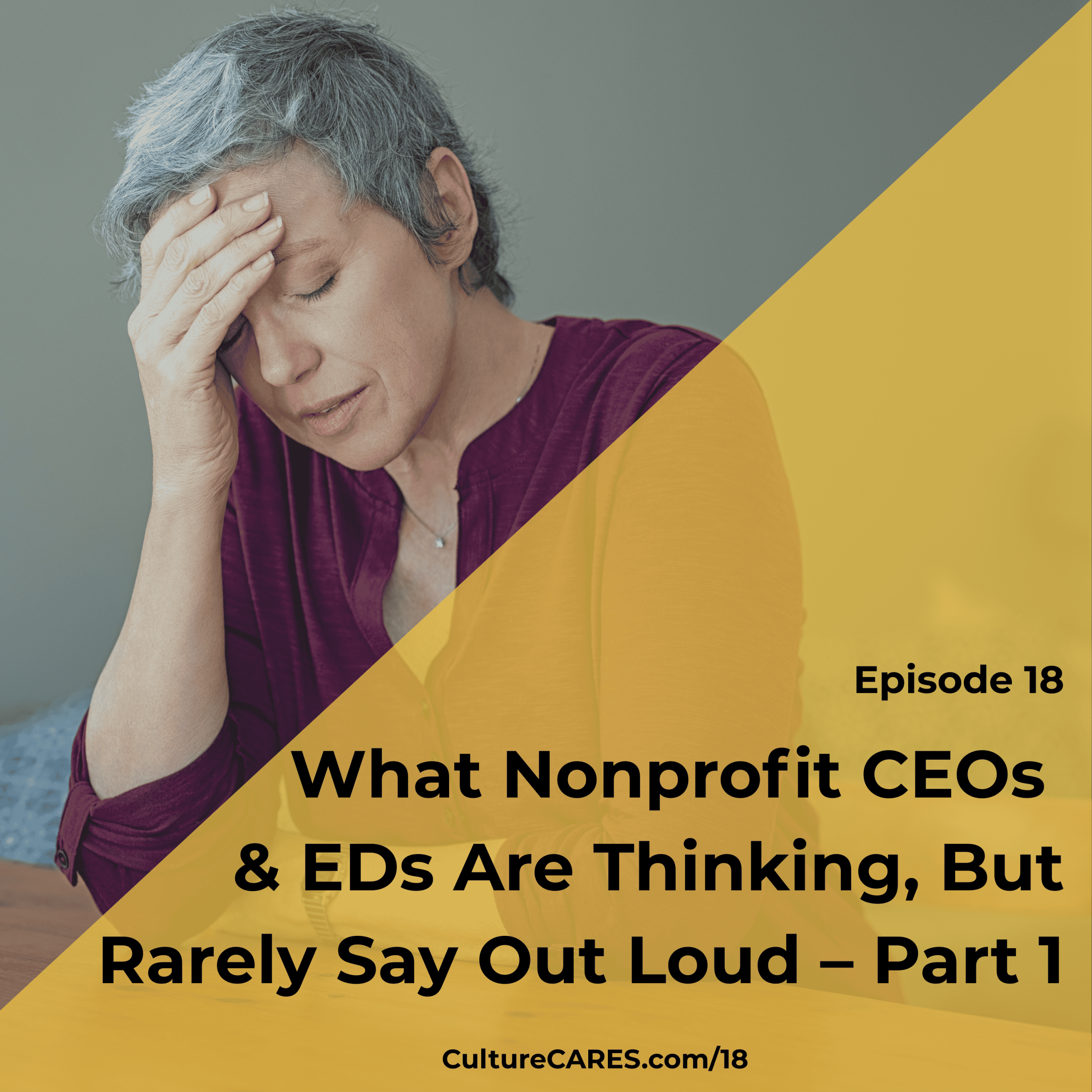

The Hidden Weight of Nonprofit Leadership
If you’ve ever walked out of a conversation with a staff member and found yourself replaying it later… wondering if you said it wrong, or if you’re expecting too much…
If you’re managing toxic team dynamics, board expectations, and the future of the organization all at the same time—and it feels like things are starting to slip just slightly out of control…
There’s a thought that can creep in that most leaders don’t say out loud.
I wonder if I’m the leader this organization needs right now.
And that’s a hard place to be.
Because you care deeply. You’re working incredibly hard. And from the outside, things might even look like they’re holding.
But inside… something feels off.
And today, I want to offer you a different way to look at that. Because what if the problem isn’t you?
What if the problem is that you’ve become the system your organization is relying on to function…And no one was ever meant to carry that alone.
Welcome to Nonprofit CEO SPARK, the podcast for nonprofit Executive Directors & CEOs who are leading through growth, change, and complexity and want to do it with more clarity, confidence, and energy.
I’m Marcia Beckner, nonprofit founder, CEO mentor, and creator of the Culture CARES® model, and this show exists to give you something most leaders don’t have,
which is a place to think strategically about your leadership experience instead of constantly performing it.
Because the truth is, most nonprofit CEOs and Executive Directors are trying to solve deeply human, complex organizational problems while quietly carrying more than anyone around them fully understands,
and that is where things start to break down, not because you are not capable, but because you are carrying too much without the right structure to support you.
The Reality of Being the Organizational Shock Absorber
I want to tell you about Mary.
Mary is a nonprofit Executive Director, and from the outside, her organization looks like it is doing well.
She’s got 20 staff members – it’s a $3M organization and a pillar in the community helping to provide mental health support to people in need.
There is forward movement, the team is mostly intact, and there is enough visible progress that most people – including her board members – assume things are on track.
Mary loves her mission, especially the parts that involve visioning, building her team, mentoring emerging leaders, creating systems that actually work,
and turning strategy to real impact in the community, and she is very good at seeing the bigger picture and translating it into something her team can act on.
She has done the hard work of stabilizing the organization in ways that really matter, when she first stepped in to the job 4 years ago,
she helped create clarity, trust, and direction, which is something she is deeply proud of and should be.
But over time – things change, and what people don’t see is the cost of stabilizing during incredibly difficult external pressures – like political and economic changes –
and internal pressures like staff turnover and pressure to raise more money every year.
Mary has become the one who absorbs everything. She often wonders, who can I vent to?
She wonders, why aren’t we humanizing the role of Executive Director? You’re supposed to have it all together – all the time – AND she is often afraid to admit what she doesn’t know.
She is holding staff stress, board opinions, funding pressure, and the tension that comes with trying to evolve a culture while still keeping the organization functioning day to day,
and she does it well, which is part of the problem, because when you do it well, people start to rely on you to keep doing it without realizing what it is taking from you.
She gives her team credit constantly, she creates emotional safety so they can perform, and she invests deeply in their growth,
but there is no real place where she gets to land, and over time, that starts to feel like a quiet form of being underappreciated,
not because she needs status or constant applause, but because the full weight of her role is not fully seen.
Managing Internal Friction and Governance Pressure
At the same time, the organization is continually dealing with change and uncertainty.
And the hardest part is that the culture is not just struggling, there are one or two people on the team who are actively derailing it, sometimes in subtle ways,
sometimes through resistance or behavior that does not align, and it has taken almost all of Mary’s energy to manage it.
She is having the same conversations over and over again, trying to be thoughtful, trying to be fair, trying to maintain relationships while also trying to protect the team and uphold standards.
She told me about a moment where she was sitting across from a team member addressing behavior that had been impacting others,
and she was choosing her words carefully because she wanted to handle it well, and partway through the conversation the team member leaned back and said,
“I just feel like expectations keep changing, it’s hard to know what you really want.”
And in that moment, Mary felt that familiar mix of frustration and self-doubt, because she knew the expectations had been communicated and she knew the behavior was not aligned,
but she still found herself questioning whether she had said it clearly enough or whether she was being too hard,
and instead of holding the line fully, she softened, she adjusted, and she walked out of that conversation knowing nothing had actually changed and that she would be back in the same place again soon.
And then there is another layer that makes all of this even more painful.
Some of that frustration is not staying within the team.
Staff are reaching out directly to board members to share concerns or question decisions,
and now Mary is not only managing internal culture dynamics, she is also managing how those dynamics are being interpreted at the governance level,
and it starts to feel like her leadership is being discussed in rooms she is not in, without full context, without the full picture of what she is navigating every day.
Staffing changes create an outsized burden, funding still feels uncertain, and instead of building momentum, Mary feels like she is “chronically behind”,
constantly managing drag – you know like a headwind in your face blowing your hair back and trying to move through mud – where every step forward is met with something that pulls the organization back.
She finds herself asking, how long do I have to personally sacrifice myself to get the work done?
Breaking the Cycle of Personal Sacrifice
And underneath all of that is a quieter fear she has not fully said out loud, which is if nothing changes in the next six months, what is this going to cost.
Because she can see it.
She can see trust eroding, strong performers starting to disengage, the board beginning to question her leadership more directly,
and funders sensing that something is off even if they cannot name it, and she also knows that she will not be able to keep leading like this indefinitely.
And what it feels like is this.
It is like she is standing in the middle of the organization holding up the entire structure with her own arms, keeping everything in place so it does not shift or crack,
while at the same time there are a few people inside pushing against the walls back on her.
From the outside, everything still looks intact, but inside she can feel the strain, because the structure is not actually holding itself yet, she is, and this was never meant to be held by one person.
And this is the moment where Mary realized that this is not something she can solve with more effort or more patience,
because the issue is not just the people, it is that the structure is not holding the culture.
And once she could see that clearly, everything started to shift, not overnight, but in a way that finally felt sustainable.
And that’s the work we do inside the Culture CARES® Accelerator, my VIP mentoring program—where you don’t have to keep being the one holding everything together…
because we build a culture and structure that can finally hold it with you.
As we began to implement the Culture CARES® system, what changed was not just how Mary was leading, but how the organization itself was functioning.
She started to feel relieved in a way she had not felt in a long time, her energy came back, and she rebuilt a self-care routine and personal life that had slowly disappeared under the weight of the role.
Her work-life balance improved in a way that actually felt real, and she told me at one point that she felt like a different person, both personally and professionally.
Building a Sustainable Growth Engine
Her team changed as well.
They were happier, more engaged, and working with each other instead of against each other, and she had a leadership team that was truly backing her up instead of relying on her for everything.
Her board noticed the shift and felt more confident in her leadership, and there was a renewed sense of trust and alignment.
Most importantly, this was not something she did alone.
She co-created a healthy and inclusive culture with her staff, which created shared ownership, and they addressed team challenges at the root rather than continuing to manage symptoms.
They became clear about who they were hiring and retaining, their standards rose, performance improved, and they met fundraising goals earlier without burning out the team in the process.
Over time, they built a reputation as an organization that people genuinely want to work for, and funders noticed that, which made it easier to attract the talent and support they needed.
And this is why I say this so clearly.
Culture is your growth engine.
When team dynamics are off, even slightly, your organization will not reach its full potential, and when culture is strong, aligned, and healthy, everything accelerates.
Ninety-nine percent of your success depends on your people, and your people want to grow in an environment that is healthy for them and for you,
and when you build that kind of culture, not only does your organization thrive, but your life feels completely different and, most importantly, sustainable.
So if you are listening and you see yourself in Mary’s story, I want you to reflect on three things this week.
Where are you currently acting as the system instead of leading one.
What would need to change for your leadership to feel sustainable, not just effective.
And what is one step you can take to move from carrying everything to building something that can hold the work with you.
And if you are at that point where you know something has to change, I invite you to visit CultureCARES.com and learn more about the Culture CARES® Accelerator on the mentoring tab.
This is where we do the deeper work of helping you build a culture and leadership structure that is aligned, sustainable, and capable of supporting both your team and you as the leader.
And while you are there, be sure to subscribe to my newsletter, where I share weekly leadership and culture insights designed to help you create a healthier organization,
strengthen your well-being, and actually enjoy your life and leadership role again.
And as you move into your week, I want to leave you with this.
You are meant for great things… and you don’t have to burn out to prove it.