
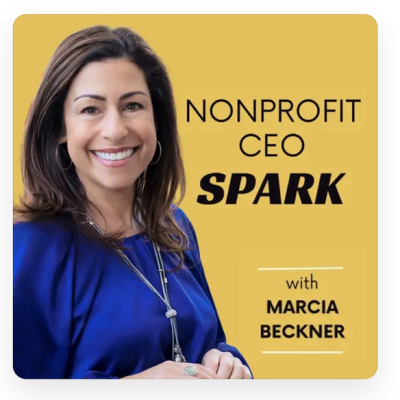
Welcome back to Nonprofit CEO SPARK and our Leading with Confidence series, where we talk about the real dynamics underneath healthy leadership, strong teams, and sustainable nonprofit growth.
Today’s conversation started with a puzzle piece I didn’t realize I was missing.
A few years into becoming an executive director, I got a mentor who helped me understand the difference between leadership and management in a way that completely changed how I built teams and scaled our organization.
At the time, I was frustrated.
The mission was growing. People believed in what we were building. We were gaining traction externally.
But internally, things often felt harder than they should.
Projects took longer than expected. Systems felt clunky. Processes weren’t streamlined. Important details occasionally lived in my head instead of somewhere useful and organized.
I could see the future of the organization very clearly.
I could inspire people around it.
I could build partnerships and momentum.
But operational infrastructure? That was a very different muscle.
And my mentor said something that changed everything for me.
He said, “Marcia, leadership and management are different skill sets. You don’t need to become a different person. You need to build a complementary team.”
That sentence gave me so much freedom.
Because up until then, I thought strong executive directors were supposed to naturally excel at everything.
Vision.
People.
Culture.
Fundraising.
Operations.
Systems.
Strategy.
Execution.
Details.
Communication.
Finance.
Basically some mythical nonprofit unicorn who somehow color-codes spreadsheets while simultaneously inspiring donors with a compelling strategic vision over coffee.
And once I understood the distinction between leadership and management, I stopped trying to force myself into strengths that didn’t come naturally and started building intentionally around them.
That’s when our organization truly began gaining healthier momentum.
Not because I suddenly became an operations genius overnight.
But because the right people were finally sitting around the table.
And I think this conversation matters because many nonprofit leaders unknowingly build organizations around their blind spots instead of around complementary strengths.
In the nonprofit world, we tend to overvalue self-sacrifice and under-value strategic self-awareness.
We quietly assume:
“If I care enough, I should be able to do all of this well.”
But leadership maturity often sounds more like:
“This is where I’m strongest. This is where I’m weaker. And this is what the organization needs around me.”
That’s very different.
In simple terms, leaders focus on vision, people, direction, culture, and long-term movement.
Managers focus on execution, systems, clarity, coordination, and operational consistency.
Leaders ask:
Where are we going?
Managers ask:
How do we get there effectively?
And after a few minutes, most people listening probably already know which side they naturally lean toward.
You can usually tell by what energizes you.
If you walk away from a strategic vision conversation feeling energized and alive, you may naturally lean toward leadership.
If you walk away from reorganizing workflows, improving systems, clarifying priorities, and tightening execution feeling deeply satisfied, you may naturally lean toward management.
And for the record, I deeply admire people who love systems because they are the reason many organizations function at all.
I remember one operations leader I worked with who opened Asana the way some people open a spa app.
Pure joy.
Calm nervous system.
Total happiness.
Meanwhile, I looked at workflow charts the way some people look at assembling IKEA furniture without instructions.
Completely different wiring.
But here’s where this gets really interesting.
The strongest organizations are rarely built around one extraordinary person.
They’re usually built around complementary leadership at the top.
Someone holding vision.
Someone strengthening execution.
Someone scanning the horizon.
Someone stabilizing the runway.
When those skill sets work together well, organizations begin operating at a completely different level.
And this matters even more during growth.
Because nonprofit growth exposes weaknesses fast.
A visionary founder can often get an organization from zero to momentum through passion, relationships, storytelling, and pure force of belief.
But eventually growth requires operational maturity.
The organization outgrows improvisation.
What once worked through hustle alone starts creating friction.
Communication gets messy.
Decision-making slows down.
Staff become unclear on priorities.
Projects bottleneck.
People burn out.
And this is often the exact point where leaders mistakenly think:
“We just need more hardworking people.”
But many times what the organization actually needs is stronger management infrastructure.
Clearer workflows.
Decision clarity.
Communication systems.
Role alignment.
Priority management.
Gallup’s workplace research continues to show that managers account for roughly 70% of the variance in team engagement. That’s enormous.
Because managers shape the daily experience of work.
And daily experience becomes culture.
Culture is not built primarily in retreat centers with inspirational PowerPoint slides.
Culture is built in recurring interactions.
How meetings feel.
Whether priorities constantly change.
How conflict gets handled.
Whether communication is clear.
Whether staff feel trusted.
Whether workloads are realistic.
Whether managers create stability or confusion.
One workplace study found that 90% of employees who left a job said their boss influenced their decision to leave.
And nonprofit leaders sometimes underestimate this because they think:
“But people love the mission.”
Yes.
And mission-driven people still need healthy work environments.
In fact, because nonprofit work is emotionally demanding, healthy management becomes even more important.
Strong managers protect teams from unnecessary chaos.
Strong leaders protect teams from losing connection to purpose.
Both matter.
And one of the more advanced leadership shifts I’ve learned over time is this:
Great leaders are not constantly asking,
“How do I become better at everything?”
They’re asking:
“How do I build an ecosystem of strengths around the mission?”
That changes everything.
Because now the conversation becomes:
What does the organization need at this stage of growth?
Where are our gaps?
Where are decisions getting stuck?
Where are staff losing energy?
Where are systems breaking down?
What strengths are missing at the leadership level?
Sometimes organizations have strong management but weak leadership.
Everything is efficient, but people feel emotionally disconnected, uninspired, or resistant to change.
Other organizations have powerful leadership energy but weak management systems.
Everyone is inspired but exhausted.
That’s what I call “mission-driven chaos.”
Beautiful intentions.
Thirty-seven exciting ideas.
No one knows which Google Doc is final.
And if we’re being truthful, many nonprofits swing back and forth between those two extremes.
The healthiest organizations learn how to integrate both.
And for leaders who naturally lean toward management, this conversation is important too.
Because leadership can absolutely be developed.
You may not naturally love public speaking or visionary storytelling, but leadership is also about curiosity, emotional intelligence, trust-building, communication, and helping people feel connected to meaningful work.
Managers become stronger leaders when they:
Share more context, not just tasks.
Communicate vision, not just deadlines.
Coach instead of only directing.
Recognize strengths intentionally.
Help staff grow, not just perform.
Likewise, visionary leaders become healthier when they strengthen operational discipline and partner with people who balance their blind spots.
This is where leadership teams become incredibly powerful.
Not clones of each other.
Not power struggles.
Not everyone trying to lead the exact same way.
But complementary strengths aligned around the same mission.
And when that happens, organizations gain traction in a completely different way.
The culture becomes steadier.
Staff trust increases.
Decision-making improves.
Retention improves.
People stop operating in constant survival mode.
The organization begins to feel less like turbulence and more like sustainable forward movement.
So if you’re listening today, here’s the reflection I’d leave you with:
Are you naturally stronger in leadership or management?
What energizes you most?
What drains you most?
What strengths are missing around you?
And are you building your organization around complementary talent… or around the assumption that you personally have to carry every skill set yourself?
Because confidence as a nonprofit leader is not built from pretending to be good at everything.
It’s built from self-awareness, strategic partnership, and building healthy teams that allow people to thrive together.
And that is what creates organizations capable of lasting impact.
Thank you so much for being here today.
And if this episode resonated with you, share it with another nonprofit CEO or executive director who might need this reminder right now.
Until next time, keep leading with confidence, courage, and care.
And remember:
Culture is your growth engine.
