
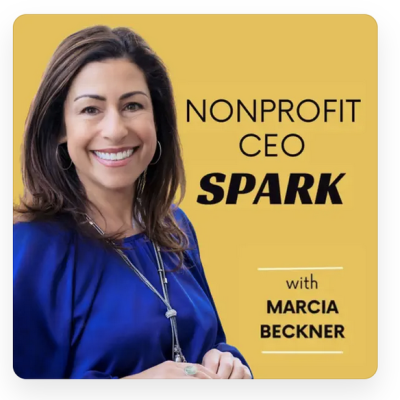
Marcia Beckner
Welcome back to the Nonprofit CEO Spark podcast. I’m your host, Marcia Beckner.
Today’s guest brings over 30 years of experience leading and building social impact organizations, and I’m so excited to have him on the show.
Dr. Rob Harter is a sought-after speaker and facilitator, and he is the host of the Nonprofit Leadership Podcast, which I had the privilege of being on recently.
He’s a member of and contributor to the Forbes Nonprofit Council, and in 2021 was invited to join Harvard Business School’s Young American Leaders Program.
His community involvement runs deep. Rob serves on the Park City Chamber of Commerce and the Utah Advisory Committee for the U.S. Global Leadership Coalition.
He chaired the MLK Jr. Commission for Human Rights for the State of Utah and previously served as chair of Utah’s nonprofit associations board, and many, many other things. So many awards.
He is also a certified professional coach, and he now works with leaders in both the social impact and private sectors, helping them draw on their strengths to lead more effectively.
And that’s what we’re going to be talking about today, leadership development and strategic planning. Rob, welcome to the show. I’m really looking forward to this conversation.
Dr. Rob Harter
Absolutely, yeah. Thanks for inviting me. I’m really excited for the conversation as well.
Marcia Beckner
Well, you’ve led nonprofits for almost 30 years, 18 of them at the executive level.
What’s one moment earlier in your career that completely changed how you think about leadership?
Dr. Rob Harter
Yeah, you know, it’s an interesting example. I think right off the bat is when you’ve been under poor leadership, and I’m not being hypercritical.
But I remember being under a particular leader that was not an empowering leader, was somebody who really was more about them and their leadership and what they wanted.
Versus what was the group wanting to do together as a team to accomplish a mission together.
So there was this real sense of not leading by empowerment or leading by coming alongside and supporting and empowering each one of the leaders to feel like, hey, I have a role here, and I can do something kind of unique.
And so I realized, once I get to a position where I could be the lead, the executive director, or the CEO of an organization, I just remembered—that’s not the type of leadership I want to pass on.
So ironically, it was a difficult season of leadership, and it was a painful experience. But I learned, hey, that gave me more fuel to make sure I didn’t do that once I progressed in my own leadership roles and responsibility.
So I think that painful situation really just taught me a lot of the type of leader I wanted to be, and the type of organizations that I wanted to be a part of, and the type of culture that really gets built when you have effective leadership.
Marcia Beckner
Oh, it’s so true. Like we can really learn so much from the painful things that happen versus when things are going well, right?
Dr. Rob Harter
Yeah, exactly.
Marcia Beckner
I had that experience in my 20s where I had a horrible supervisor in my role, and she was just led by a ruler—just rigid.
You didn’t follow this rule, smack you. It was really a bad culture.
And then the next place I went to work had the most amazing leader who became my mentor and just wanted the best for everyone in the company.
I was like, oh my! It was like China and France. What a difference! Like just two different countries, you know, the same individual as me.
And I just learned so much from those opposing ways that you can really use your leadership position as a way to lean into people’s strengths and empower them, like you were saying.
So yeah, I think everyone listening right now can relate to like, oh yeah, this was that painful experience with that manager, that supervisor, that leader. That’s where I learned the most.
Dr. Rob Harter
Yeah, yeah, agreed. Yeah,
Marcia Beckner
That’s so good. Thank you for starting us off that way.
Dr. Rob Harter
Yeah, exactly.
Rethinking Nonprofit Culture
Marcia Beckner
You mentioned culture, which is like my favorite word.
So a lot of nonprofit culture says things like “we’re a family” or “we’re mission driven, so we push through burnout together.”
Is that actually hurting morale more than helping it? And the real question I want to ask you is—what’s the conventional wisdom in the sector around team culture at nonprofits that you think is dead wrong?
Dr. Rob Harter
That’s a great question. I think maybe it’s the dichotomy sometimes between what you say are your values and maybe whatever’s on the wall in your organization.
Like, hey, these are our top core values, and here’s our mission and vision. But then how you treat your staff, how you treat each other—that’s really where the rubber meets the road, so to speak.
It doesn’t matter what you say and how well you’ve put together a strategic plan. It’s how you treat each other day in and day out. That’s really where I think culture happens.
So I think maybe where there’s a disconnect is you can talk a lot about culture, and you can have a lot of high-sounding ideals, but it really comes down to living it out.
One of the best ways is to actually start—you have your values, and then you put your values into your strategic plan. You operationalize your values.
That’s I think the difference that really separates nonprofits that have a really healthy culture and nonprofits that want to have a healthy culture but they’re struggling with it—operationalizing your values.
So you really put into practice this is what our value says. So therefore, it’s going to shape everything we do, how we treat each other, how we do our programs, how we do mission accomplishment, how we raise money.
So I think that’s the difference, Marcia. Is that switch to actually doing it, putting into practice—that sounds really obvious. But I guess I’ve been part of organizations where that doesn’t always happen.
Again, everything looks good. They’ve got the right things on the wall. They’ve said the right things on their website, but they don’t actually live it out, and they’ve not operationalized their values.
That is a really intentional step. It does take some time as well to do that well.
And then here’s the last piece I would just say: how do you know if you’ve really done it well? Is there accountability around those values being operationalized?
In other words, there’s some mechanism you got to build into your organization in terms of setting goals and how you treat people, and even in evaluations of your team.
Are you going to follow up and say, “Well, here’s the values we set out to do. Do we actually live them out?” So you’re measuring people based on the operationalization of those values.
And if you don’t do that, then it just remains a nice placard on the wall, but it doesn’t really change the culture.
Marcia Beckner
I love it.
Building a Strategic Plan That Actually Works
Marcia Beckner
So you’re really an expert in strategic planning. So tell me how you think about strategic planning with your clients, and what’s the starting place there?
We’re recording this podcast—this episode is going to air towards the end of September. So everyone towards the end of September is kind of bracing for Q4 and fundraising and possibly budgeting for next year.
So when someone brings you in, how do you set the stage, and what do they need to think about first if you’re an executive director or CEO?
Dr. Rob Harter
Yeah, strategic planning is so important, right? Well, I’ll just back up a little bit. Number one, I am a big believer in breaking up your year into quarterly chunks, if you will, every 90 days.
And it’s not original to me—you’ve heard many people say, “What are your big rocks that you want to get done?” And you can just turn those into quarterly rocks, the big rocks that you want to do every quarter.
So you start from whenever you do your planning. Some people I know do all their planning in the summer because it’s maybe a little slower, so you get away with the team and have your staff retreat.
You set the goals then for the next year, but it’s more of a July to June versus a calendar year. So regardless of wherever you start, you create these quarterly rocks for every quarter.
And then, like you said, now we’re in quarter four—assuming you had a January to December strategic plan, that’s how you map out everything in terms of setting your goals and your KPIs.
Now you’re at a place where you’re raising a lot of money, and there’s a lot going on. Typically, it’s a heavy program time for a lot of nonprofit organizations.
So my hope is you’ve planned well in advance what you wanted to get to and what you’re aiming for for Q4, so that you’re not surprised or scrambling because Q4 is so important, particularly on the donor side.
A lot of people give, even if your fiscal year is July to June, that’s when donors typically give—at the end of the calendar year for tax purposes, of course.
So that is a huge time to make sure your whole organization is really rallying around that donor cause and making sure you’re making connections. Because if you miss your goal with the donor, that impacts the entire organization.
So my big takeaway, just for this short amount of time, is to come up with a real clear plan. Take your time to really map out at least a year in advance.
And sometimes, if you can do a three-year strategic plan and then back up and do a quarter at a time, that’s really the best.
So that way, every 90 days you can look at things, analyze. Did we hit this goal or did we not? If not, let’s retool—maybe we need to reevaluate, maybe some goals were just too lofty or not realistic.
So having that regular mechanism built in, I think, will help you get to the place where you don’t panic when you get to a Q4 where it’s really busy and everyone has no more time to set aside to do that strategic thinking.
So that would be one of my recommendations.
Marcia Beckner
Yeah, so many nonprofits may be busier during the school year if they have programming during school, or they may be busier during the summer because they have programming.
Dr. Rob Harter
That’s right.
Marcia Beckner
So everyone’s got their own cadence and calendar to look at. But obviously on a slower time, hopefully there’s a slower time in your program, and there might not be. But you’ve got to set aside time.
Who should be in the room doing the strategic plan?
Dr. Rob Harter
Yeah, okay. So I would say whoever ultimately both shapes the organization’s decisions and owns them.
Certainly, back up to say here’s how most organizations are set up in the nonprofit world. You’ve got the board, and they typically empower the executive director, who then leads the rest of the staff.
So the board is not overseeing the entire staff; they just oversee the executive director. So that’s most set up that way.
So assuming that’s how your organization’s set up, the executive director at the end of the day, I think it’s their decision of who’s in that room.
But I always run it through the filter of who’s going to shape the decision making, and then who’s going to own those decisions.
So, if you’ve got somebody who can shape the decision, but they’re not going to own it, then they probably don’t need to be in the room for that conversation.
Here’s another thing behind that question—you may have some volunteers right now in positions that, if you had a bigger budget, would be staff members because they really shape the organization’s decision making and the future of that organization, and they will own it.
They will implement whatever you decide in that room or in that strategic planning retreat. They will own it, and they will be on the ground level, boots on the ground, making that decision, owning it, and living it out.
So if there’s some volunteers in that category, bring them, invite them in, because a lot of nonprofit organizations—actually every nonprofit organization—depends on volunteers.
And so I am a big believer, if they carry the weight of what a normal staff member would, because you don’t have the budget to pay them, bring them into those decision-making processes, because that is so important.
Again, one of the things I work a lot with, both private sector companies as well as nonprofits, is if you have this great strategic plan and these quarterly rocks, but if you don’t assign individual people to actually own that big rock you’ve decided to do, it’s really difficult to have any ownership.
Because then it kind of goes to the group, but no one’s going to really take ownership for it. That’s why I’m a real believer—you decide on one person who primarily owns one decision, one rock, one big goal.
And then whoever is that person, they need to implement it. And if they need help from the team, of course, then they reach back out to the team.
But there is an ownership piece, because that’s where accountability comes in, and that’s where we have a sense that we all play a part in this.
Marcia Beckner
And how does a really solid strategic plan that’s been co-created with the right owners work? Because what’s that saying—you will implement what you helped create?
People are bought in when they help create the solution. So instead of just handing down a binder and saying “now go implement this,” whoever is owning a piece of this plan should be in the room to help craft the solution and the goal and the plan.
Dr. Rob Harter
totally agrees with you. If you don’t have input, you are not going to have ownership typically.
But if you want to have ownership, say you have a volunteer that’s running your food pantry, but they don’t have any input—it’s really hard for them to own whatever decision was made when they’re actually doing the work.
So bring them in, let them have input, and guess what? Their ownership will go up to the percentage of how much input they have. That’s what I’m a big believer in, for sure.
Accountability, Milestones, and Team Buy-In
Marcia Beckner
Yeah, and this accountability piece is really where I think a lot of strategic plans fail. They either get put into that binder and the retreat is over, sent out to everyone in a PowerPoint or PDF, and then what happens?
Is it always the CEO or executive director who has to keep that as a living document? Keep checking through it, keep asking people who are accountable for different pieces to report back and report any barriers to getting further on that goal?
Like, what is that implementation plan with the accountability piece that you see? How do you make that succeed?
Dr. Rob Harter
Yeah, that is another great question, and I recommend that you have a rhythm of weekly meetings with whoever those key decision makers are.
Now, some people are like, “well, we’re just too busy, or we have multiple campuses, sometimes we’re even spread over multiple cities.” So what do you do?
Well, you can always use a tool like Asana or some other tool that you can just put your report or update in, and people can read it. But ideally, it’s in person or even a Zoom call, and you keep that meeting tight.
But you always are checking in on a regular basis, and the executive director, I think, is the one who leads that meeting and initiates it.
But there’s an understanding—we’re a group together. We’re going to have group accountability, and by sharing in that group, everyone knows that so-and-so is responsible for this big rock, and so-and-so is responsible for that big rock.
And so they report back knowing that it’s their responsibility versus just the executive director doing that. So the more you can do it as a team, the better.
Again, ideally, I think it’s a weekly thing. Even if it’s maybe one week is just a remote check-in through Asana or whatever tool you like to use, and then maybe twice a month to get together, or maybe once a month.
I wouldn’t do any less than once a month in person, or everyone’s on the same Zoom call, going through those responsibility measures you said you would follow up on.
That’s minimum, because you can’t just meet once and then wait three months, and then say, hey, here’s where we are, I’m way off where I was supposed to be. So you have to have regular check-ins.
And I also think it can’t just be on the executive director. Obviously that person is going to be the one that initiates it, but everyone needs to feel the responsibility and the weight of that ownership.
And doing it as a team, I think, allows that to happen much better.
Marcia Beckner
Yeah, I would also add celebrating the little milestones along the way, making sure that you’re recognizing all the successes, even the small tiny ones along the way, because it is going to be small successes that lead to the big thing.
And the terminology you’re using, like “rocks,” is from Entrepreneurs Operating System, EOS. So I wanted to attribute that to them.
Dr. Rob Harter
That’s exactly right. Yeah, you’re exactly right. Correct.
Marcia Beckner
I love how they turn everything from the strategic plan into these quarterly rocks and these weekly tactical meetings that keep everybody accountable.
Like, “what’d you say you’d do last week, and what are we doing, and let’s talk about any issues right now”—what’s getting in our way that we might need to revise, or one of the goals or something.
But just really good communication, I think, is the key to a really strong strategic planning success.
And then, how does this dovetail for you into leadership development in your role? Are those two separate things, or is it something you tie in together?
Dr. Rob Harter
Yeah. Well, okay, that’s a great question in terms of how do you weave all this together.
Part of what I do now, often I’ll work with an organization, and there’ll be these quarterly rock meetings, and I’ll work with the entire team, and then we’ll provide coaching for the individual executives.
Perhaps each one of the members of that decision-making team will get executive coaching, so you could have some leadership development individually, in addition to the whole group working through a strategic plan.
So that is a nice combination that we’ve provided, and other people provide as well.
But I also think you said something really, really important. I think as you go along and you’re accomplishing these milestones, even if they’re small, I am a huge believer in celebrating whatever those wins are.
Because it’s too easy to get into a “what have you done for me lately” mode, and you have a constant check-in, and it’s all kind of almost like you come across assuming the person’s not gotten their job done.
And so it comes across much more of a heavy, look-over-your-shoulder, micromanaging feel—versus, hey, we’re so excited to celebrate what’s going on. Tell us what the win is.
So I think that is also—what kind of culture are you developing? Good leaders, in my mind, create this culture of celebration.
A phrase, again not original to me, but once I heard it I loved this phrase—I’ve forgotten where I picked it up, but I use it all the time in my coaching. It’s this: celebrate the gains, not the gaps.
In other words, we all have these gaps between where we want to be, or where we are today, and where we want to be. There’s often a big gap, and this is organizationally, also individually.
And so we often focus on those gaps, and we’re always like, “oh well, we’re not quite there, we’re maybe 50% there or 60%.”
If you flip that around and just change your mindset to say, “let’s celebrate the gains—how far have you gotten towards your goal?” That flips around to be much more of a positive check-in.
Versus, “well, you’re this far short”—no, you’re this much closer to your goal. It’s just that small little shift from gaps to gains, and that is all about leadership development in my mind.
Because as a leader, you’re trying to empower your team, you’re trying to encourage your team, you’re coming alongside and being a big cheerleader for your team, rooting them on to their success.
And by celebrating the wins and really recognizing even if they’re small wins, I think that goes a long way to create this really supportive atmosphere, this sense of empowering all the people on your team.
And I think that then they look forward to whether it be weekly meetings, monthly meetings, whenever you meet, because maybe someone’s going to get a shout out.
There’s going to be some kind of win, like hey, let’s celebrate—so-and-so had this big win. That’s the kind of spirit in my mind. That’s the kind of meeting I want to go to, whether I’m on a team or the leader of that team.
So that’s one way you can start developing leadership as you’re doing your strategic planning.
Marcia Beckner
Yeah, that is so important. So you’re talking about the Gap and the Gain by Dan Sullivan. We read all the same books.
Dr. Rob Harter
Oh, there it is. Okay, Dan Sullivan, I couldn’t remember. I got that. Yes, exactly. Sullivan. Yeah, okay, thanks for reminding me.
Marcia Beckner
And that’s his book, if you want to check it out, The Gap and the Gain.
I think we all struggle with this because we’re human beings, and we’re mostly in this leadership role because we want to succeed. We’re high achievers. We’ve got big goals.
We have to raise big money to serve more people, and so we’re always like, we’re not there yet. There’s more people we haven’t served, there’s more money we need for another team member that we haven’t raised yet.
So you’ve got to be really intentional to look backwards and say, look at this last quarter—we’ve served this many more people, we’ve raised this much more money, we’ve built our culture.
We’ve really strengthened retention on our staff, which is saving us money and resources. And look, as a leader, you’re looking for the things that are working constantly, because that’s going to fuel motivation for your people into the next quarter.
And as you were talking, I was also thinking about my son, who’s in college, and he’s got this academic coach. He was struggling with his grades, and he found this coach himself.
He admired who he was as a coach, and has been working with him every week. His grades have completely—well, I would say it’s not just the grades that are much better, which they are—it’s because his work ethic and the accountability that this coach had for him was so strong.
My son said it in the way where he said, “I don’t go to those meetings not having done what I said I would do, because I respect this coach so much, I don’t want to disappoint him.”
Dr. Rob Harter
Yes, yes, that’s good.
Marcia Beckner
As a leader, you can think about—that’s why culture is so important. You want your people to be self-motivated, self-accountable, because they respect you so much and the team and the mission, that they’re not going to drop the ball.
So you have this high-performing team that doesn’t drop the ball, and that’s how you keep moving forward. And just like that Gap and the Gain story you shared, that just really clicked for me. Yes, that’s how it works.
Dr. Rob Harter
Yeah, it’s a great example. I do think it’s a choice, right? The leader, whoever’s setting the ultimate example, is the CEO or the executive director. Really gets to set the pace for that and create that culture, and then people will rise to that culture.
And I think you said something very significant with your son’s example. That coach was a personal relationship, right? So it was a personal connection, and there is accountability with it.
So it’s a both-end thing. It’s not just building a relationship, but no accountability. No—it’s accountability with the relationship. That’s the best combination, right?
Because then you’re motivated, in a sense, whether it be not to disappoint the person, or just because you have so much respect for the person. And I think that’s really exactly how leaders should see it.
And it doesn’t mean you have to become best friends with your team. It just means you’re relational enough that you’re really there for their betterment.
It’s not about what you’re going to get from them so much as how much you can build that connection. And it’s all about the mission.
Whatever the organization you’re with is like—my job as executive director is to help us together collectively get to this mission. So it’s not them working for you. It’s we’re working all together for the mission.
And I think that’s a different mindset, and I think you can celebrate better when you have that mindset.
Marcia Beckner
Yeah, and you have the opportunity as the executive director to have leverage if you are fortunate enough to have a team to help you.
Dr. Rob Harter
That’s right. That’s right. Good point.
Marcia Beckner
Yeah, if you’re fortunate enough to have a staff, really also start by respecting them. Because I think in my son’s example, his coach came to him with respect, even though he was the student.
He showed him respect, and that instantly—if you show someone respect, it’s easier for that mutual respect to build, rather than expecting it because “I’m your boss.” That usually doesn’t work.
We’ve all been in situations like that; we know that doesn’t work. But when you have a manager, let’s say an executive director who’s listening, who has a manager on their team that thinks they should have respect because they have a title—that’s a performance conversation to have with your manager.
Because as the executive director with a staff, your biggest leverage to succeed is your team. So helping them reach their full potential—and you can’t do that without mutual respect around everybody.
And if anyone is disrespecting others, that is just going to pull like an anchor down to the bottom of the ocean, and you’re just going to struggle.
So level-setting that we all respect each other not because of title, but because we are people working on the same team, rowing in the same direction.
Involving New Team Members and Motivational Values
Marcia Beckner
This is our strategic plan that you’ve helped us come together with—or if the person wasn’t there, let’s say you just hired someone and you do have to hand them “this is our strategic plan you’re responsible for implementing.”
Do you have any advice or guidance as to how to get someone who wasn’t part of the strategic planning process to really believe in the plan and implement it?
Dr. Rob Harter
Yeah, that one’s tough. That one’s a hard one. I think because ideally, those who are going to implement it, they need to be part of that process. But you’re right, as you get bigger, it gets more difficult to get everybody at the table.
So a couple ideas I have for that—create some kind of mechanism, even if it’s, we’ll just throw out a number, we’ll just say you have eight people on your strategic team that have made the strategic plan.
Maybe within the eight, each one of them has, for lack of a better term, like a table of people, leaders, volunteers, perhaps, that are underneath them directly.
And they could have—I’d recommend if you could have a breakout where they have their key people within their team or department, and they discuss the strategic plan.
And maybe if it’s already been set, and they’re like, “nope, we’re going to do it, we’re going forward, it’s too late, we got to go”—again, I recommend bringing them in on the front end.
But if it’s already done, and you’re in a situation where the strategic plan is already in place, or maybe a new staff member comes in halfway through your strategic plan.
Then, as you do these quarterly meetings, definitely lean into them and say, “tell us what you think. I know you weren’t part of it, you didn’t have a lot of input on the front end, but what do you think now?”
Bring them in as soon as possible to have input and feedback on what they can do to get better at meeting whatever goal you’ve set, so that at least you’re getting them as much input as you can after the fact.
And then the next time around, make sure that they are part of that table, so to speak, of having some input.
One of the things, another phrase that I heard one of my guests on my show mention, is that not everyone has a vote, but everyone should have a voice. And that may be a phrase that people need to remember.
Even if you’re a low person on the totem pole, so to speak, and you really don’t have a vote at the end of the day for the final decision, because as the organization grows, not everyone has an equal vote, and I get that.
But everyone should have an equal voice. They should at least be able to speak into the situation, give their perspective from their department, from wherever they stand in their organization. That is where I think we miss it.
Just because you think they don’t have a vote doesn’t mean they can’t have a voice. And then what you have to do is just say, “hey, thank you so much for your feedback and all your input. We couldn’t implement all the wonderful ideas we got or all the feedback, but what we did was collectively listen to all of your voices, and here’s what we’ve decided for now.”
And so I think most people understand that they can’t just have their way. But I think if you don’t even give them a voice, then you have a problem.
And I found, ironically—you may know this from some people on your show—but we’ve had a lot of conversations about this next generation coming in, like Gen Z, for example, really wants to have a voice at the table, even if they don’t have a vote at the table.
So, in particular, if you have a lot of younger generation members joining your organization, they’re probably even more sensitive than previous generations about wanting to be part of that decision-making process, even though they’re new, even though they’re young.
So, give them a voice, even if they don’t have a vote, and just explain that, and I think that’ll help a lot.
Marcia Beckner
I do too. I just had an epiphany while you were talking about why that’s important to Gen Z. They’ve had a voice and a vote most of their lives. Look at social media—oh, I like this, vote for that.
That is their brain wired, like, of course they want to hear from me. Of course they want me to like it. Of course they want me to love it, right?
Dr. Rob Harter
And us—that’s a great point.
Marcia Beckner
You know, millennials slash Gen Xers, we were used to like, well, the adults pick what we do. Because they’ve been here longer at work, the more experienced coworkers.
Of course they know more than me, because we didn’t know as much as young people. We didn’t have as much power, democratic power, that the internet gives us.
Dr. Rob Harter
That’s a great point, Marcia. I think you’re right. I think you’re absolutely right.
Marcia Beckner
I do too. Yeah, I’m like—
Dr. Rob Harter
Good insight. That’s your next episode. Yeah.
Marcia Beckner
Well, generational differences is such a hot topic. Anytime I write a newsletter or do a show on Gen Z, we’re all trying to figure this out and get our newest employees, our youngest employees, plugged in on the same page as us as soon as possible.
They want more flexibility, they want more say in things, and I’m always trying to figure out the psychology behind it. I was an organizational psychology major, so I’m like, oh, I didn’t know that, okay, like why is this?
So I don’t know, I just—that epiphany just popped in my head, and I wanted to share it.
Dr. Rob Harter
I think you’re right. I think there’s something to that. Absolutely.
Marcia Beckner
Yeah, and not just to be frustrated, like, oh, they’re so entitled. Well, they grew up totally differently than we did, and they’re not as interested in learning about our way because it’s the old way. So it’s just how all generations are.
Dr. Rob Harter
Yeah, right. Yep.
Marcia Beckner
I was in my 20s thinking all the older people knew nothing, so I’m sure like they’re—that’s just like, we all would do that.
Yeah, we also just have a little compassion, that that’s just where their development cycle is.
But yeah, so giving them a voice, I love that. I think that should be the takeaway quote: not everyone gets a vote, but everyone should have a voice.
And really, I think that’s what they’re asking for, and with that trust and respect, if you’ve built that in advance, proactively, they will take the news that their suggestion wasn’t input into the plan, and they’ll be okay with it, because they trust that you listened to them, which is really what they wanted.
Dr. Rob Harter
That’s right. That’s right. Exactly. Yeah.
Marcia Beckner
And just kind of figure out a way to incorporate their ideas in other areas.
Dr. Rob Harter
Exactly.
Closing Thoughts and Action Steps
Marcia Beckner
Well, as we wrap up, thank you so much for your time. I love talking about strategic planning, forward thinking about Q4 fundraising. I know that’s on our minds right now.
Is there any small actionable thing when it comes to strategic planning that you think people can think about? It could be around getting the budget ready, or the strategic planning team, and how to start to pursue their next strategic planning. What is an action step that they could take?
Dr. Rob Harter
Yeah, that’s a good question. Okay, so maybe what I would say is this: it doesn’t maybe strike you right away as a part of a strategic planning process, but I’ll explain this.
One of the things I’ve done before with the team I’ve led is give them a list of 12 values—motivational values, meaning what motivates them at work.
It could be a list of things like the pay, my compensation. It could be I want to be in on conversations, or I want to have freedom with my schedule, I want to be able to work from home and in the office.
Just come up with like 12 motivational values of what keeps people there, what’s most important to them, and then give it to every one of your team members.
And again, high capacity volunteers, if they fill a staff role, include them in it. The reason I would do that is then find out what the top three across the organization are—what their top three motivational values are.
Because typically we assume things. Oh, it’s all about compensation, or we want to have flexibility with our schedules. And so you may be doing really good work with your strategic plan, moving forward with goals and KPIs, but you’re losing buy-in because you’re not hitting those motivational values.
So I think buy-in is this underrated, really key role of keeping your team fired up and excited to go after your strategic plan.
So it’s almost like backing up a little bit to say, if you’re finding there’s a little bit of a lack of buy-in, a lack of motivation, or even worse case, some quiet quitting going on with your team—go back to the motivational values, find out what that is, and then lead from that place.
Knowing that oh wow, we need to really—it’s not just about compensation, for example. Maybe it’s this whole issue we talked about, voice versus vote. I know that Gen Z really wants to be involved with this decision making.
And if you’re not allowing them enough, maybe that’s why your strategic plan is not really taking off, because they never really felt like they had a real stake in it to begin with.
So by going back to those motivational values, I think that could be a great tool that doesn’t take very long. You can just send it through an email, but then make sure you come back and talk about it, summarize the results.
Say here’s what we found, and here’s then what we’re going to do—one or two action steps of what we’re going to do in light of what we learned to make the whole strategic planning process better.
And of course, the last piece you mentioned, budgeting, is so important, right? So, if compensation was the number one value—by the way, we did it with our team, compensation was not number one.
Actually, the number one thing was they wanted to be part of an organization that had a clear mission. And that’s when you think about nonprofits, that’s what drives them, right?
So I think, okay, are we clear about what our mission is? Does everyone understand what our mission is? Is everyone bought into that mission?
If that is not the case, make sure that happens, because then your budget may be really different in terms of what you do in response to what the motivational values come out for your team.
So anyway, that may not be exactly what your question was, but I found that so important as almost like a pre-step to really effective strategic planning.
Marcia Beckner
And budgeting—that’s such a good point.
Dr. Rob Harter
And budgeting too. Yeah, exactly. That’s right.
Marcia Beckner
You’ve got to know what people value, and every person and team is different. And it’s such a great way to constantly talk about—this is going to make our culture better.
We want to be an excellent place to work where people are lit up and doing their best work and growing and learning.
So, yeah, it may be opportunities for professional development, opportunities for advancement.
Dr. Rob Harter
There you go.
Marcia Beckner
You know, exactly. Make sure that you have a lot of things on that list that don’t cost you money.
Dr. Rob Harter
Absolutely, exactly. Like freedom of their schedule, for example. Exactly, remote work. Yeah, that’s right.
Marcia Beckner
Even some less meetings might be helpful. Some people are just booked back to back, and that’s crushing their soul. But they love the mission, they’re super high performing, highly motivated.
But these back-to-back Zoom meetings—I used to work in an organization like that, it’s just exhausting.
So maybe you could implement a new meeting norm where, you know, Wednesdays are off from Zoom meetings, or every other hour just gives you space to think and process through the last meeting, prepare for the next meeting.
Go figure, you might need a little bit of a bathroom break or something. But you can incorporate that into a new meeting norm. It doesn’t cost anything.
So thank you so much, Rob. This has been great. Great questions. I think we’re really aligned in our thinking and philosophies around helping nonprofits.
Where can people find you if they want to get in touch?
Dr. Rob Harter
Yeah, two easiest ways: robharter.com, which is my name, R-O-B-H-A-R-T-E-R, robharter.com, or the Nonprofit Leadership Podcast.
Just Google both of those, then it’ll pop right to my website, and then you can reach out even if you want to connect with me.
I’m also on LinkedIn, so just put Rob Harter into LinkedIn, and I’m there quite a bit. I think you are as well, and I find that there’s a lot of great dialog and community that I’ve found actually on LinkedIn.
So that’s probably where I’m most active when it comes to these kinds of questions, leadership stuff, even more than the other socials—LinkedIn, that’s been my hangout place.
Marcia Beckner
Same, I love LinkedIn. Okay, totally. Yep. Thanks again.
Dr. Rob Harter
Absolutely.
Marcia Beckner
Yes. Just to wrap up—I always want you to remember that you are meant for great things, and you don’t have to burn out to prove it.
Before you go, I want to remind you that you don’t have to leave empty-handed today. I created a free guide for nonprofit leaders like you, covering four things: how to stop spinning out, the number one behavior you can use to lead with more conviction, the secret to building a more inclusive culture starting this week, and a simple weekly ritual that unifies your team.
It’s free, it’s fast, and it’s built to help you lead with more confidence starting today. Grab it now at culturecares.com/guide.
Thanks for listening to today’s episode of Nonprofit CEO Spark. If you’re ready to turn burnout into boundaries and build a healthy, happy culture where everyone, including you, can thrive, visit culturecares.com to learn how I support nonprofit organizations like yours.
If this episode brought you value, share it with a fellow leader navigating stress and overwhelm.
And remember, you are meant for great things, and you don’t have to burn out to prove it. Until next time, keep leading with courage and confidence.
