
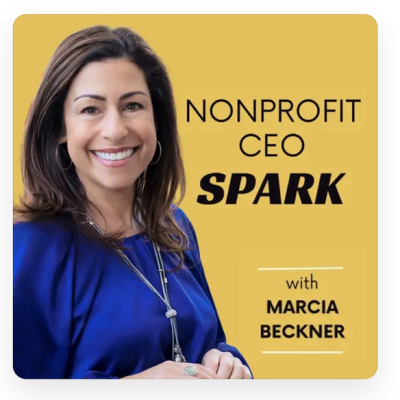
Welcome back to the Board-CEO Partnership Series. I’m Marcia Beckner, founder of Culture CARES®, and I’m so glad you’re here.
This is Episode 5 in our eight-part series designed to strengthen one of the most important relationships in any nonprofit, the partnership between the Board of Directors and the CEO or Executive Director.
Whether you’re listening as a board chair, a board member, or a CEO, my hope is that these episodes become a practical resource, something you can use to onboard new board members, facilitate an annual board retreat, or simply recalibrate how your board works together each year.
If you’re just joining us, start with Episode 1 so you can experience the series from the beginning. You’ll find the full series at CultureCARES.com/41.
I’d also encourage you to download the free companion guide in the show notes. It has reflection questions, discussion prompts, and practical exercises for each episode, so you can turn today’s conversation into action at your next board meeting.
Today we’re talking about the E in the CARES® Framework: Engagement.
I wanted to dedicate a full episode to this because it comes up in almost every coaching engagement I have.
Whether I’m working with a first-time Executive Director or the CEO of a large nonprofit, the conversation almost always turns to the board.
“I have three board members doing eighty percent of the work.”
“Everyone comes to meetings, but very few people actually participate.”
“Our board cares deeply about the mission, I just can’t seem to get people engaged.”
If any of that sounds familiar, you’re not alone.
Most nonprofit boards learn about their fiduciary duties, financial oversight, strategic planning, and hiring the CEO.
What’s harder is the relational side: building real engagement, strategic dialogue, and strong relationships with one another.
I don’t think the problem is that boards don’t care. I think we’ve been asking the wrong question.
Most governance training teaches boards what to do. Very little teaches them how to build the relationships that make those outcomes possible.
Shifting Focus From Attendance to Team Connection
That’s where engagement really begins.
If there’s one idea I hope you remember from today, it’s this:
The goal isn’t to build a board that shows up.
The goal is to build a board that shows up for each other.
A board can have perfect attendance and still be disengaged.
Everyone can read the packet, attend every meeting, vote on every motion and still leave without feeling connected to one another or invested in the collective work of the board.
Attendance is easy to measure. Engagement is deeper.
It’s measured by contribution, by curiosity, by whether people ask thoughtful questions, challenge assumptions respectfully, offer their expertise, make introductions, build on each other’s ideas.
Engagement isn’t about showing up to a meeting. It’s about showing up for the people at the table with you.
That lesson got personal for me a few years ago. I was invited to serve on the board of a nonprofit whose mission I genuinely believed in.
It was a virtual board, every meeting on Zoom. I gave financially each year, I attended faithfully, I wanted the organization to succeed.
From the outside, I probably looked like a highly engaged board member.
But if I’m honest, I never really felt connected to that board.
Every meeting followed the same pattern: log into Zoom, call to order, approve the agenda, hear the reports, vote, adjourn. Efficient.
The business got done.
But something was missing.
Looking around at all those little squares on my screen, month after month, I realized I didn’t really know the people serving alongside me.
I knew their names and their professions.
I didn’t know why they’d chosen this organization, what experiences shaped their perspective, or what they brought to the table beyond the bio I’d read when they joined.
I didn’t know them well enough to build a relationship outside the meeting itself.
I never picked up the phone to ask another board member for advice.
And when I was the new one, joining a board where others had served for years, no one called just to welcome me, to ask who I was or what I cared about.
I never thought, “You know who’d have a great take on this?” because we’d never created the space to know one another beyond the agenda.
The problem wasn’t that people skipped meetings. The problem was that we never became a team.
That experience changed how I think about board engagement entirely.
So here’s what I want you to take with you: from here on out, whenever you think you have a board engagement problem, you don’t. You have a team connection and culture problem.
Compounding Strengths Through Intentional Design
Every board member arrives with a collection of experiences, relationships, and talents, one understands finance, another has built a career in marketing, someone else has decades of fundraising experience or deep ties across the community or lived experience that gives the organization insight it can’t get anywhere else.
I think of those strengths like deposits into a shared investment account. Each has value on its own.
But the real return comes when they compound, one person’s question sparks another’s idea, a board member makes an introduction, a coffee conversation becomes a major donor relationship, a discussion at the table produces a solution no single person would’ve found alone.
That’s where extraordinary boards separate themselves from average ones.
Not because they recruited more accomplished people, because they intentionally connected the accomplished people they already had.
When we skip that step, we leave ideas on the table. We leave collaboration on the table.
Ultimately, we leave mission impact on the table.
It’s worth saying: when I founded my own nonprofit, our first board was mostly family and close friends.
We already trusted each other, so I never had to think intentionally about board culture, those relationships already existed.
It wasn’t until the board grew more professionally diverse that I realized trust doesn’t just carry over. It has to be built again, on purpose, every time.
Connection doesn’t happen by accident. It happens by design.
That’s why I believe building board culture is one of the most important shared responsibilities of the Board Chair and the CEO-Executive Director.
We tend to think of board culture as something that just emerges over time. I don’t believe that.
Culture is designed, by the questions we ask, the conversations we encourage, the experiences we intentionally create.
The same way we design a strategic planning session or a fundraising campaign, we should design opportunities for board members to actually know, trust, and appreciate one another.
Practical Strategies for Quick Wins
That doesn’t mean 30-minute icebreakers at every meeting, board members are busy volunteers, and their time is valuable.
So here’s Quick Win #1: Start every meeting with five intentional minutes of connection, before you even open the agenda.
Ask a different board member each month: “What’s one leadership lesson you’ve learned recently?”
Or, “What first drew you to this organization?”
Or, “What’s one strength you want to bring more intentionally this year?”
Five minutes doesn’t sound like much. Over a year, it changes how a board relates to one another.
People stop seeing titles. They start seeing people.
And people move the needle in our business.
Here’s Quick Win #2: Launch a Board Buddy Program.
Pair every new board member with a seasoned one for their first six to twelve months, someone who can decode the “wait, what does that acronym actually mean” questions, make a few introductions, and translate the unwritten rules nobody bothers to put in the bylaws.
It’s really hard for people to admit what they don’t know in a group setting.
They don’t want to look stupid, so make sure there is a buddy to run all questions to as they are onboarding and learning.
The buddy system shouldn’t fall on the CEO or Executive Director’s shoulders, because they have an organization to run.
The board should be accountable for their own onboarding, training, and welcoming people properly to the organization.
Because right now, here’s the status quo, and we wonder why engagement is lacking.
Most new board members get handed a three-inch binder or PDF and a cheerful “good luck out there!”
A binder has never once made a human being feel like they belong. A person can.
You spend months recruiting a great board member. Don’t let the relationship-building stop the moment they say yes.
That small investment is often the difference between someone who quietly disappears after year one and someone who’s still in the room and still showing up for their fellow board members years later.
So here’s a reflection question, for your next board meeting or maybe just the car ride home: If a new board member joined tomorrow, what intentional experiences would help them feel like they truly belong, not just to the organization, but to this team of board members?
The Doorway to Psychological Safety
And when people know one another, they trust one another and engage with the group.
Human connection is the foundation of board engagement.
But engagement alone isn’t the finish line. It’s the doorway to something even more important.
Because once a board member connects and engages, a deeper question follows: do they feel safe enough to disagree with one another?
To challenge an idea in the room, admit they don’t understand something, or say, “I think we’re about to make a mistake,” without fear of how it will land?
That’s called psychological safety. And it’s the subject of our next episode.
Decades of research proves: Psychological safety is the #1 indicator of high performance, high innovation, and high inclusion.
In fact, it’s the number one predictor of all three.
So join me for Episode 6, where we’ll explore what psychological safety actually looks like in the boardroom and how a board moves from an average group of people to a highly impactful team.
REMINDER: Go download the free companion guide in the show notes on apple, spotify, or wherever you are listening to this episode.
It has reflection questions, discussion prompts, and practical exercises for each episode, so you can turn today’s conversation into action at your next board meeting.
Until then, this is Marcia Beckner. Thank you for listening to the Board-CEO Partnership Series.
